
When Pearl Abyss announced Crimson Desert, the ambitious single-player follow-up to their smash hit, Black Desert Online, I was left feeling excited but cautious in equal measure. MMORPGs are an entirely different beast, and despite what can be considered to be one of the best implementations of a real-time combat system in the genre, a shift to a fully single-player open world game, particularly with the scope that Crimson Desert aims to cultivate, creates expectations that are hard to live up to.
For those worried about enjoying Crimson Desert without prior knowledge or playtime with Pearl Abyss’s last game, can rest assured in knowing that, despite Crimson Desert taking place in the same universe as Black Desert Online, newcomers will have no trouble following the story of the game. Crimson Desert opens strong, showing the downfall of Kliff and his ragtag group of mercenaries, known as the Greymanes, after the brutish Black Bears, an equally imposing group of bandits and ruffians, leave them for dead.

After falling off a ledge that should have killed our dear protagonist, Kliff instead finds himself spirited away into a mysterious pocket dimension, known as the Abyss. From here, players are quickly given a tutorial on the basic gameplay loop of Crimson Desert. Before discussing the combat and side ventures, players should be made aware that Crimson Desert borrows many gameplay elements from modern Zelda titles, specifically Breath of the Wild and Tears of the Kingdom.
In Crimson Desert, these Zelda-like elements directly translate into Force Push and grab mechanics, which essentially let you manipulate objects in 3D space. These Force abilities are used in both combat scenarios and to solve the many environmental puzzles strewn about the land of Pywel.
“Perhaps a side effect of designing an MMORPG tailor-made for the PC platform, Crimson Desert has a context problem when playing with a controller.”
Perhaps a side effect of designing an MMORPG tailor-made for the PC platform, Crimson Desert has a context problem when playing with a controller. Holding the left bumper prompts Kliff with a reticle that can hover over the environment, much like moving a cursor with a mouse. Crimson Desert often asks the player to hold the left bumper while pressing one of the face buttons to sift through context-appropriate prompts to reach the desired outcome. The finite control of hovering between items and context-sensitive prompts works well enough, but things can quickly become frustrating when dealing with the many, many Force-based environmental puzzles the game throws at the player.

Simply aligning, say, for example, a stone totem to match the glyphs in the correct pattern can be finicky, as the game expects perfect alignment, making what would be an easy puzzle more frustrating than it needs to be. The reliance on precision is exacerbated when the player is meant to move objects in 3D space, such as during a part of the game in which a series of furnaces explode. Instead of clicking into place, furnace pieces must be rotated in 3D space, much like Zelda, but in a way that feels overly clunky and unintuitive, resulting in busywork that slows progression and disrupts the pacing of the experience.
Crimson Desert also doesn’t hold your hand when it comes to hints or solutions for environmental-based puzzles, which, on paper, sounds like a good thing. Sadly, the clunky nature of the Force abilities, coupled with poor wording or context clues, can ruin progress, sometimes even requiring a restart. An example of this occurs during a boss fight after a prolonged puzzle sequence, when a rift opens, ending with an encounter with a flying enemy.
The game prompts players to approach the boss while holding the LB and RB bumpers, which should blind enemies by reflecting light from your blade. In reality, however, the boss is only damageable by flying towards it and ignoring the instructions the game throws at you, with the blinding technique adding nothing of value to the fight. Dying to said boss also results in having to redo the entire section of puzzles that leads up to the encounter. Instances like the above are peppered throughout the game, though not as egregious as the tower encounter—there is a definite inconsistency in when the game decides to give the player a checkpoint.

Cutscenes can be fast-forwarded through, but the speed feels closer to watching a YouTube video at 1.5x, which can be tedious after numerous attempts. A simple skip button to end the scene would have been a much better solution. Kliff, as a character, also feels severely underutilized, as he plays more like a mute protagonist who reacts to his environment than a proactive hero. One saving grace that Pearl Abyss does well is the way in which Kliff and company rebuild the remnants of the Greymanes’ homestead.
Instead of a safe but boring series of quests that reunite Kliff with his comrades, Crimson Desert gives players an entire camp infrastructure to manage and expand. Players can send members of the Greymanes out into the world, which slowly raises the overall level of your base. It adds a fun meta diversion to the main gameplay loop. If I had to nitpick, however, some of the menus and markers tied to the management systems can feel messy and hard to read. Hopefully, the day-one version of the game will address those issues, because the base expansion and housing mechanics in Crimson Desert can be a lot of fun.
On the topic of story, the voice acting in Crimson Desert is excellent, especially alongside the harrowing opening that leads into a larger plot about Pywel, a land wracked by uncertainty after the king succumbs to a mysterious coma. There is a real sense of scale and intrigue with the large cast of characters, particularly Kliff’s fellow Greymanes, who have distinct personalities that make them feel alive. Unfortunately, in contrast, Kliff himself can feel a bit hollow, making him more like a Jon Snow stand-in rather than someone wholly original or interesting on his own merits.

Crimson Desert also allows players to switch to different characters, which is a cool feature on paper. Still, like several other systems in the game, this mechanic feels underbaked outside of combat. Most of the story and side content can only be played as Kliff. In practice, there is little reason to switch, despite some cool and unique combat styles that feel distinct from the Greymane warrior who appear much later in the 60-plus-hour adventure.
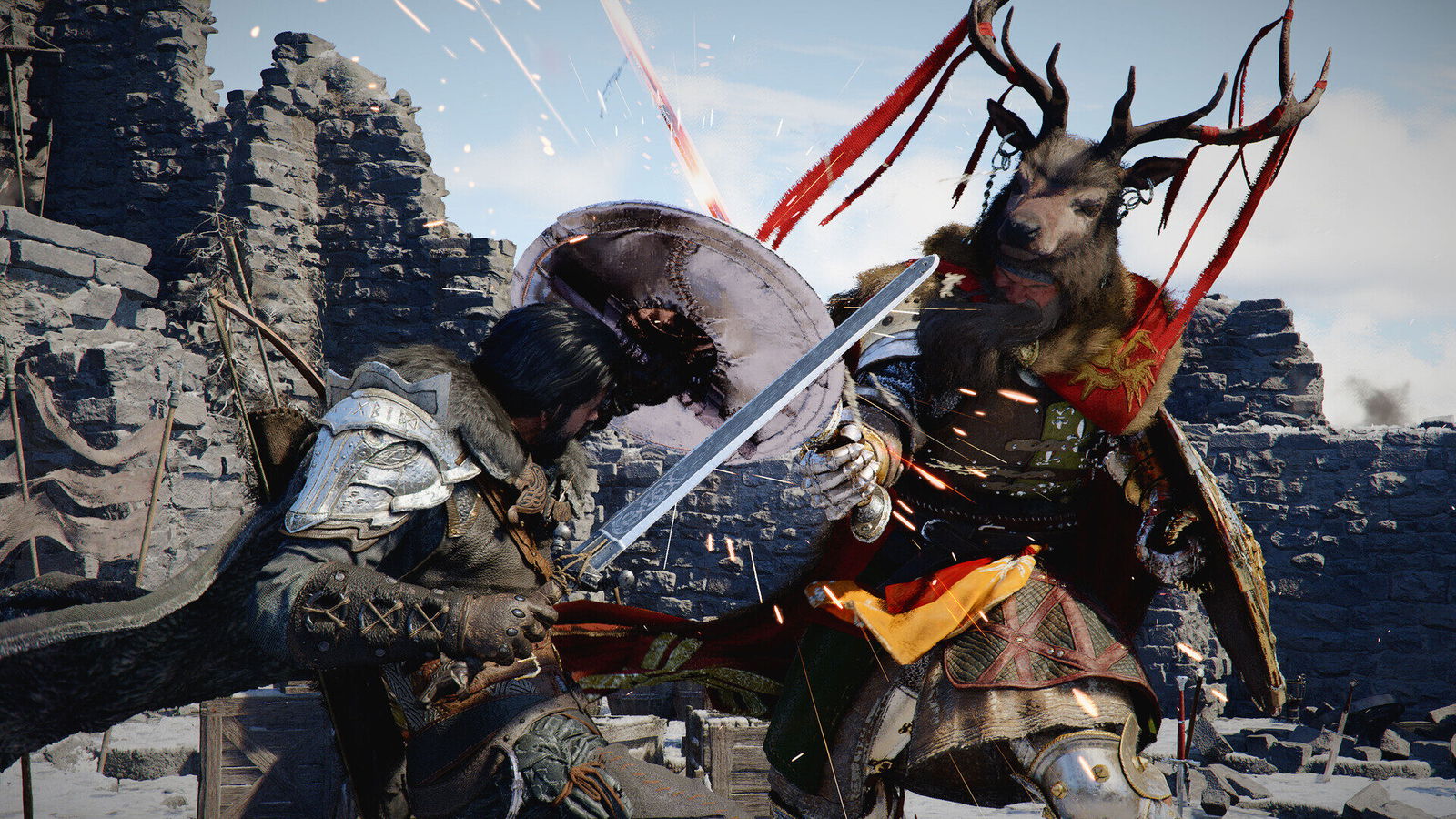
Crimson Desert truly shines when it does its own thing instead of trying to ape other open-world games. Combat, in particular, feels quite good, coupled with excellent verticality afforded by the flying ability and a Spider-Man-esque grapple. Weapon variety is also fantastic, including everything from standard swords and bows to guns, hammers, two-handed weapons and even just your fists, all of which feel impactful and satisfying to master. An expansive skill tree augments the combat even further, eventually granting players magic-imbued attacks and movement tech that feel as liberating as its open-world setting. In other words, if you are just looking for a massive sandbox to get lost in and fight things, Crimson Desert has you covered.
Boss encounters are the real skill test in Crimson Desert. At first, they feel satisfying to overcome, forcing players to explore the world, upgrade their gear and take on side quests. Unfortunately, after a while, bosses start to feel more like unfair sponges that siphon the player’s healing items, making fights feel more like battles of attrition than tests of skill and might. Those who stick with it are rewarded with a real sense of satisfaction. At the very least, the game does a good job of conveying power scaling between mobs of enemies and the unique bosses that stand apart from them.

Additionally, while magic is present from the start, Crimson Desert does an excellent job of slowly introducing more fantastical elements, such as exotic mounts and more menacing enemies that lean into dark fantasy aesthetics as players progress through the game.
“Crimson Desert truly shines when it does its own thing, instead of trying to ape other open-world games.”
Finally, on the topic of side quests and activities, Crimson Desert features a healthy assortment of extra content. Although side quests themselves don’t particularly stand out, they do feature fully voiced lines of dialogue, making them worth pursuing for those who want to experience everything the game has on offer. One interesting mechanic in how some side quests and recipes manifest is the manner in which they are learned and acquired. Instead of simply pressing a button prompt, the camera will shift to a first-person perspective, showing Kliff absorb the material in a way that feels more immersive and unique.
Side activities, such as mining and logging, also feel well-realized, going beyond simply pressing a button for a canned animation to play out. For example, cutting a tree will have it fall in a more realistic manner, one that mostly respects the environment around the player. From here, the player must then cut larger segments into logs, something that again adds to the immersion and feels oddly satisfying for something as simple as resource collecting.

PC performance is excellent, at least on my Radeon 7900XTX when using FSR 2.0, which netted me a mostly pristine 4k image with a silky smooth FPS. Controller input also felt good, with the game having no problem discerning between my X-input-based controller and Dualsense gamepad. Finally, support for ultrawide resolutions also meant I was able to enjoy Crimson Desert on my non-conventional Samsung Zfold device, which utilizes a 21:9 aspect ratio when streaming the game over Apollo.
That all being said, Crimson Desert is a solid effort, featuring excellent combat and a massive, gorgeous open world, one that shows Pearl Abyss is not afraid to try new things. Taking a closer look, however, reveals several smaller issues that do not quite come together. These include an overly finicky interaction system, a strong story and cast of characters let down by a boring protagonist, and uneven spikes in difficulty combined with some obtuse or vague gameplay hints. Together, these problems create an uneven experience that keeps the game from truly soaring to the lofty heights it aims for.