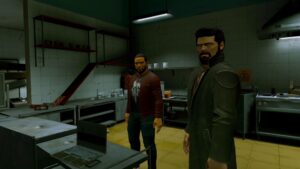


High on Life 2 feels like a game that knows exactly what people are going to show up for, but never quite figures out how to maintain being a fun game around those expectations. If you played the first one, you are probably here for the talking guns, the off-kilter jokes, the chaotic alien worlds, and that very specific Squanch Games tone that somehow blends Saturday morning cartoon energy with deeply online humour. And to be fair, a lot of that is still here. The problem is that almost everything around it feels shakier, messier, and far less confident than the original, to the point where the cracks stop being charming and start actively getting in the way.
At a glance, High on Life 2 looks like a more ambitious game. The environments are larger, denser, and clearly designed to encourage more movement and verticality. You can feel from the outset that there is a real push to make traversal feel like part of the fun rather than just the connective tissue between jokes and gunfights.

The skateboarding mechanic is the clearest example of this, and it’s easily one of the sequel’s strongest additions. Zipping around alien cities, chaining momentum, and launching yourself off ramps feels good in a very immediate, tactile way. When it works, it adds a sense of flow that the first game never really attempted, and for brief stretches, it almost feels like the game is about to click into something genuinely special.
Unfortunately, those moments don’t last nearly long enough.
Combat, which was already a bit of a mixed bag in the first High on Life, somehow feels way flatter here. The guns still do their thing and talk, and fight, and they still occasionally land a joke that catches you off guard, but the actual act of shooting things rarely feels anything close to satisfying. Enemy encounters seemingly blur together quickly, and without strong audio or musical backing, a lot of gunfights end up feeling strangely empty.

There were multiple gunfights where the music simply didn’t kick in at all, leaving me skating and shooting through what should have been high-energy fights in near silence. It’s the kind of technical issue that completely drains tension and momentum, and it happened often enough that it stopped feeling like a fluke and started feeling like a pattern.
And that’s kind of the story of High on Life 2: technical issues out the wazoo. I lost track of how many times I had to reload checkpoints because something broke, didn’t trigger properly, or just softlocked me because the skateboard or one of the bat-wielding enemies made me go out of bounds. Sometimes an objective wouldn’t update. Other times, a door wouldn’t open, or a scripted moment would just… not happen, or enemies needed to be killed would just phase through walls, and I would sit there waiting for them to show back up before I could continue.
“High on Life 2 feels like a game that knows exactly what people are going to show up for, but never quite figures out how to maintain being a fun game around those expectations.”
There was once, after getting a carburetor, when I was told the RV would come down and pick me up, so I waited for a few minutes with nothing happening around me, only to have to reload twice to get the RV to actually show up. None of these issues was game-breaking on its own, but taken together, they add up to a constant sense of friction. Instead of getting lost in the absurdity of the world, I was always half-expecting the game to hiccup, and that’s a terrible mindset for a comedy-driven experience.

The level design doesn’t help matters. The new layouts are clearly meant to feel more open and exploratory, but they often cross the line into outright confusion. Exploration stops being fun the moment it feels mandatory and unintuitive, and High on Life 2 hits that wall far too often. Not to mention the platforming comes with a lot of friction. One point in particular had me jumping from log to log while moving upstream, and I would just phase through logs, or the grapple command just wouldn’t work.
What’s especially frustrating is that the first game actually understood pacing pretty well. It knew when to slow down, when to let a joke breathe, and when to give you a quiet moment to absorb the weirdness of its universe. High on Life 2 almost never lets up. It’s always pushing you forward, always talking, always layering systems and mechanics on top of each other. There’s very little downtime, and without that contrast, the humour starts to lose its punch. Jokes need space to land, and when everything is loud all the time, nothing really stands out.
The comedy itself is… fine. That’s probably the best way to put it. There are moments that work incredibly well, and a handful of lines that got a real laugh out of me, but it doesn’t hit nearly as hard or as consistently as the original. Part of that might be how constant the jokes are, not even from the guns, but from NPCs as well; it became tiring and quickly. The shock value is gone, and the novelty of sentient guns yelling at you isn’t what it once was.

But it also feels like the writing leans a little too hard on being self-aware, constantly nudging you and saying, “See? This is the joke.” When High on Life is at its best, it trusts you to get it. When it’s at its worst, it over-explains itself, which is 2, feels like a lot more often.
That over-explanation bleeds into the gameplay as well. Tutorials last way longer than they should. I get that part of the joke is the drawn-out nature, but not knowing when things would actually work made this tiresome, overplayed timing feel bad. Mechanics are introduced with a lot of fanfare but not much depth, and the game rarely evolves its ideas beyond their initial hook. Skateboarding is fine, but it never really becomes more than cool, and the game leans too heavily on this mechanic that at best can feel kinetic and at worst and more often than not, just feel fine.
“High on Life 2 almost never lets up. It’s always pushing you forward, always talking, always layering systems and mechanics on top of each other.”
Everything feels like it’s set up to be explored more later, but that expansion never quite arrives. Even the murder mystery section, which is my favourite genre, felt half-baked and just kind of mediocre at best.

By the time the credits rolled, I was left with a very specific kind of disappointment. Not the kind that comes from a really bad game, but the kind that comes from a game that could have been better with more polish, more restraint, and a clearer understanding of what actually worked the first time around. High on Life 2 isn’t missing out on the fun or creativity because there are flashes of creativity, solid ideas, and moments where the humour and mechanics align just right. But those moments are buried under technical issues, muddled design choices, and a pacing problem that never really resolves itself.
It’s a shame, honestly. High on Life didn’t need to reinvent itself to justify a sequel. It just needed to be refined, tightened, and smoothed out the rough edges. But instead, High on Life 2 scooped everything up, without actually focusing on the fundamentals of what made the first game good. Its middling nature is above everything that makes it a bigger letdown.