
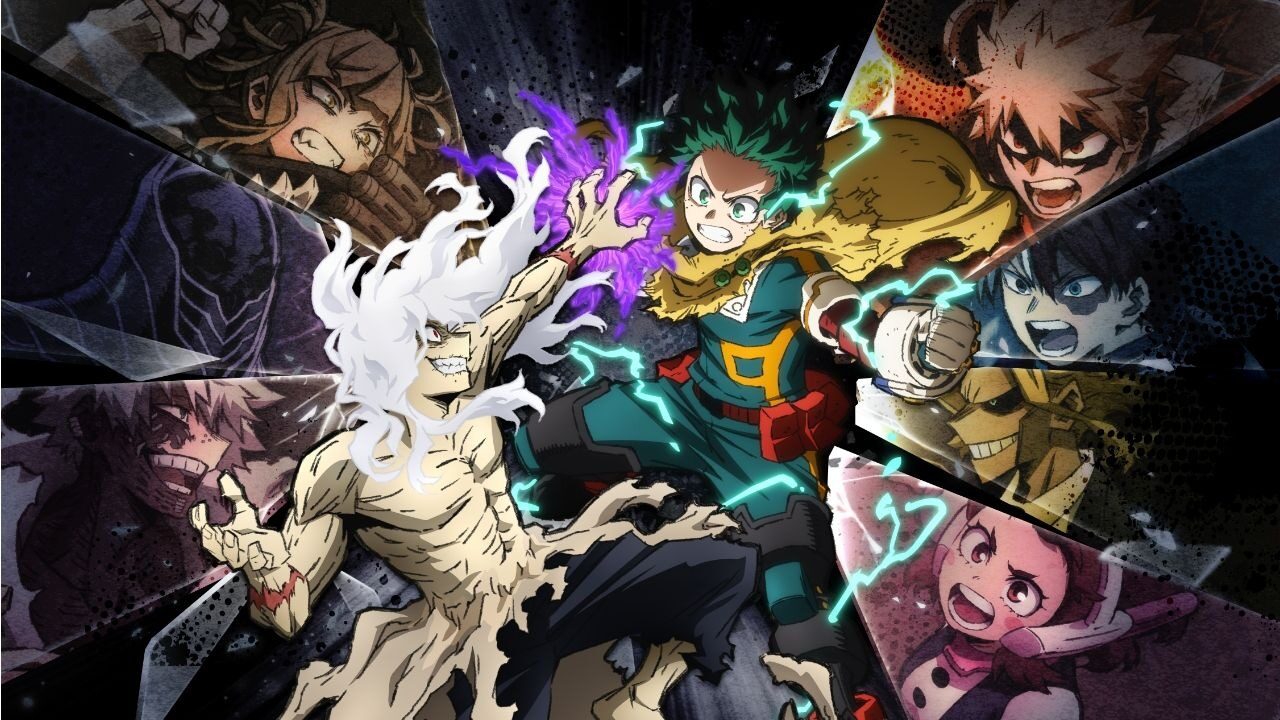
After previewing MY HERO ACADEMIA: All’s Justice in early January, the early showing promised plenty to do in this game. As this game captures the epic finale of the anime it is based on, it offers much more than that. Various game modes expand the world and provide players with an opportunity to learn more about the other characters and know what it feels like to be in their shoes.
In MY HERO ACADEMIA: All’s Justice, you will experience the epic final war between heroes and villains through dazzling 3v3 “Quirk” battles brought to life with stunning graphics. When the game starts, you will be thrown directly into the heat of a battle as Izuku “Deku” Midoriya against Shigaraki for a warm-up!

After the battle is resolved, you’ll find yourself on a town plaza, a virtual training space created specifically for the game, where All Might will be waiting for you. Talk to him and follow his introduction. Through this main stage, you’ll be able to access the various modes and functions by visiting facilities, but also enjoy random encounters with characters, discover fun mini-games and Easter eggs, as well as in-game collectible cards.
“MY HERO ACADEMIA: All’s Justice’s core strength lies in its Story Mode, which reimagines and reanimates major fights from the manga and anime.”
MY HERO ACADEMIA: All’s Justice’s core strength lies in its Story Mode, which reimagines and reanimates major fights from the manga and anime. The animators deserve significant credit for amplifying some of the series’s best battles and, in several cases, elevating them through a vivid colour palette that suits the game’s comic-book style. The game adopts a more cel-shaded look for its characters and environments, resulting in cleaner visuals and high-quality graphics.
The main criticism of the Story Mode is the way some dialogue scenes are handled. Several moments are cheapened by the use of static JPEG images taken directly from the anime. The developers attempt to add energy by including voice acting from the original cast, but the images are merely shaken on screen and overlaid with action lines, creating an awkward sense of motion. The result looks inexpensive and unfinished. It gives the impression that the development team ran out of either budget or time to recreate these scenes within the game engine.

As I said in MY HERO ACADEMIA: All’s Justice’s preview, Demon Slayer: Kimetsu no Yaiba – The Hinokami Chronicles 1 and 2 set the bar for superbly reanimating story beats from the anime within the game. There was not a single moment when I felt like the devs at CyberConnect2 had cut quality to add as much anime content as much as possible. Whereas MY HERO ACADEMIA: All’s Justice leaned into adding more quantity in this game.
Most fighting games typically have those two game modes at their core, with some small inconsequential minigames. This My Hero Academia game had that, and then some more. Hero’s Story and Team-Up Missions were an okay addition to the game, as they felt very cheap and an afterthought.
Players are treated to side quests that Deku picks up from various UA teachers, including the likes of All Might and Gran Torino. While Team-Up Missions are cool to see the rest of Deku’s UA classmates and teachers, the missions can be so one-dimensional. For example, one of the missions was to follow Shota Aizawa around the city—just to see what he does with his spare time. It matched the kids’ energy, as if something a child would do in real life, but it was also tedious for a video game.

Another strength of this game was that it had two combat styles to play: one was the more typical 1v1 battle style that players of Bleach: Rebirth of Souls or Dragon Ball: Sparking! Zero would recognize, and the other had a more open-arena feel to match the city fight vibes. The Story Mode used the former, while Team-Up Missions and Hero’s Diary used the latter.
“As is, this fighting game barely edges out what could have been a mobile game available on PC as well.”
The open-arena structure supports the storytelling, but it quickly feels stale due to the constant encounters with generic enemies between missions, often labelled as “Suspicious Man 1” and “Suspicious Man 2.” The experience is further weakened by repetitive voice lines, which become increasingly grating by the end of each fight, particularly in Team-Up Missions. After nearly every encounter, Deku repeats, “Was I able to save you?” This line is heard countless times as players cycle through frequent battles with random gang members and Nomus in the streets.
If MY HERO ACADEMIA: All’s Justice is the final game based on the anime series, it serves as a respectable conclusion that offers fans some supplementary content. With My Hero Academia: Vigilantes continuing to air, there may still be an opportunity to add new material to the game in the future. While the overall concept is appealing, the added filler content ultimately does not justify the game’s cost. The design suggests an attempt to emulate a Spider-Man–style experience, but it comes across as underdeveloped, as if the developers ran out of time or budget.

The overall design seemed to indicate that Story Mode and Battle Mode were where most of the budget went, and then the open-world aspect was shoehorned in to fill the price gap and make players feel like they are getting more out of the game. It felt ambitious to make this a semi-open-world experience, and its flaws showed. If Byking could make a couple more refinements to some gameplay movements, the game could play a bit better. As is, this fighting game barely edges out what could have been a mobile game available on PC as well.