
Planet of Lana was one of several unexpected indie delights I had the pleasure of playing in 2023. So when I discovered about a year ago that the sequel, Planet of Lana II: Children of the Leaf, had already been announced and was in full production by developer Wishfully and publisher Thunderful Publishing, I made sure to add it to my wishlist. Now the game is finally here and, well, let’s just say I have some unexpected feelings about it.
Planet of Lana II: Children of the Leaf continues the adventures of the titular heroine and her “cat-like” companion Mui. After miraculously saving Tailo Village and their loved ones from the robotic alien threat in the first game, the pair are enjoying a period of peace and harmony alongside the rebooted machines that once enslaved humanity centuries ago.

However, Lana and her people are not the only human settlement living on the planet Novo. Two other factions have emerged, and each has embraced the machines and the technology left behind after the robotic invasion in very different ways.
“Planet of Lana II: Children of the Leaf continues this approach, along with the painterly, watercolour-inspired visual style.”
When the Dijinghala, the most technologically advanced and militant of these societies, attacks Lana’s village and poisons one of her young friends with a chemical weapon, Tailo Village is reluctantly drawn into conflict. Despite Lana and Mui having likely saved the entire planet, Lana’s protective older sister and guardian, Elo, forbids her from joining the fight because she is still too young. Instead, the village elder Rakuen gives Lana and Mui a different mission: find the rare ingredients needed to create an antidote that can save her friend’s life.
Naturally, those ingredients are scattered across Novo’s remote regions, which means Lana and Mui will once again set out on a journey across the planet’s landscapes. This time, the adventure takes them through several entirely new biomes waiting to be explored.

Just like in the original Planet of Lana, players control both Lana and Mui as they work together using their unique abilities to evade enemy creatures, machines and hostile humans, all with the goal of once again rescuing the inhabitants of Tailo Village. Lana, now 13 years old, is more confident, agile and determined than the girl she was two years ago. However, she has also grown somewhat reckless, much to Elo and Rakuen’s chagrin. Meanwhile, the seemingly ageless Mui still fears water, but when it comes to protecting Lana and her friends, Mui remains as faithful and courageous as ever, and its telepathic abilities have only grown stronger.
Much like a cat, Mui can perform giant leaps to reach areas that Lana cannot access. It can also activate simple switches, use telepathy to stun or short-circuit robots, take control of other creatures or machines and more. Lana, on the other hand, serves as both the brains and the brawn of the duo. Among other things, she can swim, run, slide, climb and manipulate both simple and complex switches. She can also direct Mui to time its actions in concert with her own to solve puzzles and navigate obstacles.
Some puzzles or scenarios require the duo to split up temporarily, but Lana and Mui are rarely more than one screen apart during gameplay, as their objective is always to move forward together. The 2023 release Planet of Lana featured a simple yet effective narrative, in part because all of the game’s dialogue was performed in a unique alien language, with English appearing only in menus and within a song or two from the orchestral soundtrack.

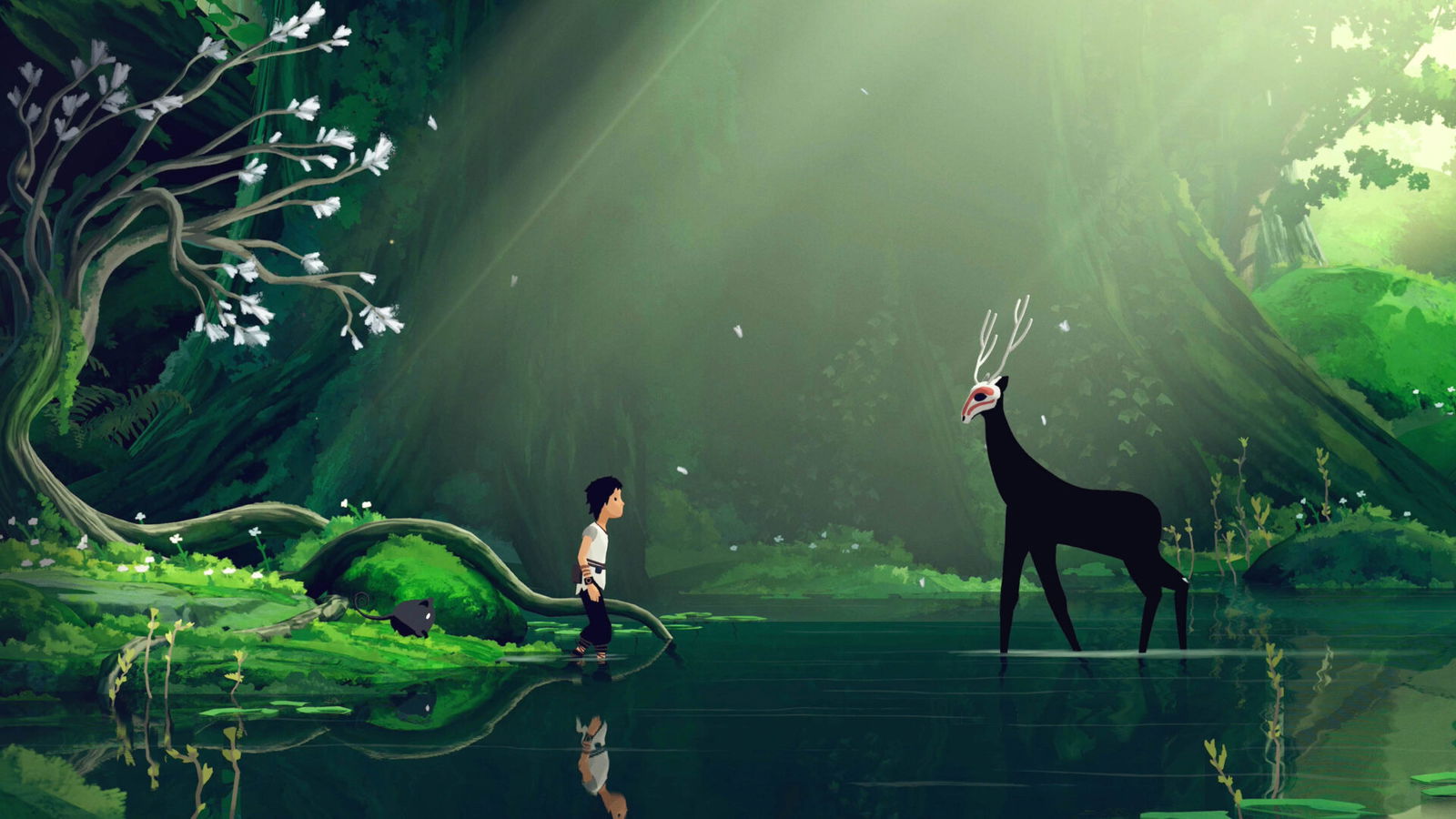
Planet of Lana II: Children of the Leaf continues this approach, along with the painterly, watercolour-inspired visual style that has evolved from the original game, showcasing more detail and layered depth. The human characters still resemble paper cut-outs in some animations when viewed up close or during cutscenes, but otherwise the world looks exquisitely vibrant and colourful.
“The puzzles in Planet of Lana II hit a little differently…”
Japanese-American composer Takeshi Furukawa (The Last Guardian, Planet of Lana) returns to the series, delivering a moving companion piece to the original game’s soundtrack and its easily recognizable theme. Adam Stjärnljus, co-director of the first game, also returns as creative director for Planet of Lana II.
Ok, so about those feelings I mentioned I have about Lana II’s gameplay… I’ve never been the best at solving 2-D environmental puzzles, but I was at least good enough at them to finish the original Planet of Lana nearly three years ago, and while there were definitely some challenging obstacles in the mid-to-late game that had me wracking my brain for a while, in general I was able to complete most of them in a reasonable amount of time and proudly celebrate each small victory with a sense of satisfaction and accomplishment.

The puzzles in Planet of Lana II hit a little differently, however. That may seem odd at first, because on the surface, it appears as though Swedish developer Wishfully is not doing anything drastically different from what it did in the first game. There is a difference, though, and it mainly comes down to this: the puzzles in Planet of Lana II simply are not as enjoyable as those in the original, at least in my opinion.
There are definitely more puzzles this time around, and many of them are far more complex than those in the first game. That makes sense given that Lana and Mui’s abilities have evolved and the challenge should naturally increase as a result.
But more is not always better.
Ideally, 2.5-D puzzle platformers like Planet of Lana II should tickle the brain, make the player feel clever and give the sense that they have accomplished something worthwhile, even if it is just an NPC offering a few words of encouragement. That experience falls apart, however, if the gameplay is not polished, consistent and complete.

While playing through the game, I often got the sense that Stjärnljus and the team at Wishfully were so eager to add more gameplay and puzzle content that some of the rough edges were never fully smoothed out.
“Planet of Lana II is a visually busy game thanks to its graphical improvements and increased environmental depth.”
For starters, Planet of Lana II is a visually busy game thanks to its graphical improvements and increased environmental depth. As a result, it is surprisingly easy to lose track of Lana or Mui within the scenery. This can lead to deadly falls or accidental deaths if the player moves either character into the open at the wrong moment.
The hostile robotic machinery found in the Dijinghala’s industrial biome is particularly guilty of this. The machines have a nasty habit of hiding in plain sight because they blend so well into the surrounding environment. Players need to stay alert and listen carefully for the robots’ familiar audio cues.

There are also a number of visual and gameplay inconsistencies that add confusion and slow the game’s momentum to a near glacial pace. Some interactive objects look similar to one another and feel as though they should be connected in function, but in the end, they are not only unrelated, they also behave in ways that do not always make sense.
For example, the yellow ropes on crates that are meant to be pushed look very similar to the yellow cables that Mui can chew through to release a rope or object for Lana to climb. This can easily lead players down dead-end paths when they become stuck and assume the mechanics are connected.
There are also several illogical inconsistencies. Wooden crates can be set on fire, but they do not continue to burn. Fire will burn strange cobwebs, but it will not melt ice barriers. Electricity, electrified water and fire also do not harm Lana in many situations, even though the game trains the player early on to avoid creatures and machines capable of emitting deadly shocks.

And do not even get me started on the puzzles involving fire trails. The “controlled burning” outcomes are wildly inconsistent and often require multiple retries to complete successfully. The mandatory and unskippable musical puzzles that players occasionally have to muddle through are equally exasperating.
“In Planet of Lana II, a lack of consistency, clarity and dependable gameplay rules leaves players with too much room for guesswork from the start.”
In my 2023 review of Planet of Lana, I cautioned that “it’s often possible to completely overthink some of the environmental puzzles and end up going down rabbit holes.” Even with that issue, however, the original game was consistent enough in its presentation and gameplay rules that nine times out of 10 I could enter an area and quickly understand what I needed to do.
I recognized the mechanisms from earlier encounters and did not need to spend the first 20 to 30 minutes simply figuring out what type of puzzle I was looking at. I was already comfortable with the game’s rules and knew what not to waste time attempting.

In Planet of Lana II, a lack of consistency, clarity and dependable gameplay rules leaves players with too much room for guesswork from the start. The result is wasted time, countless failed attempts and growing frustration with each puzzle, rather than a satisfying sense of progress. Quite frankly, the guardrails on Planet of Lana II’s puzzles need to be tighter. A menu option that offers additional hints or prompts when players have been stuck in the same area for an extended period could go a long way toward solving this problem.
A “previously learned abilities” list buried in the menus would also be extremely helpful for players who need a refresher. There are several crucial gameplay lessons that neither the original game nor Planet of Lana II clearly explains, leaving players to discover them entirely on their own. This can lead to hours of wandering as Lana, repeatedly dying and restarting from the previous checkpoint until the solution is stumbled upon by accident.
So if you have not figured out how to “layer” roller fuel to traverse gaps, use lily pads to transport Mui past water obstacles, or remember several of Lana and Mui’s key abilities from the previous game when they are suddenly required, you are going to be in for a very frustrating time. One example is temporarily stunning machines from behind, an already unlocked skill from the first game that Planet of Lana II never formally teaches you to use.

Progress in Planet of Lana II: Children of the Leaf eventually became so irritating for me because of the relentless puzzle design that I stopped looking for hidden secrets altogether. In the first game, exploring for those secrets was part of the fun. Here, I simply wanted to reach the ending without suffering more unnecessary deaths or wasting more time than I already had. And this is coming from someone who genuinely loved the first game.
Whether you should purchase Planet of Lana II: Children of the Leaf ultimately depends on two things. First, how eager you are to continue Lana and Mui’s adventures and uncover more about the lore, history and inhabitants of Novo. Second, how much challenge you want from a puzzle platformer, because puzzle solving accounts for roughly 90 per cent of the game’s overall experience.
If you are the type of player who enjoys getting stuck on a tricky brain teaser and does not mind putting the controller down before returning the next day with fresh eyes, Planet of Lana II may be right up your alley. For everyone else, I strongly recommend trying the game through Xbox Game Pass Ultimate before purchasing it outright, if you have access to that subscription.