
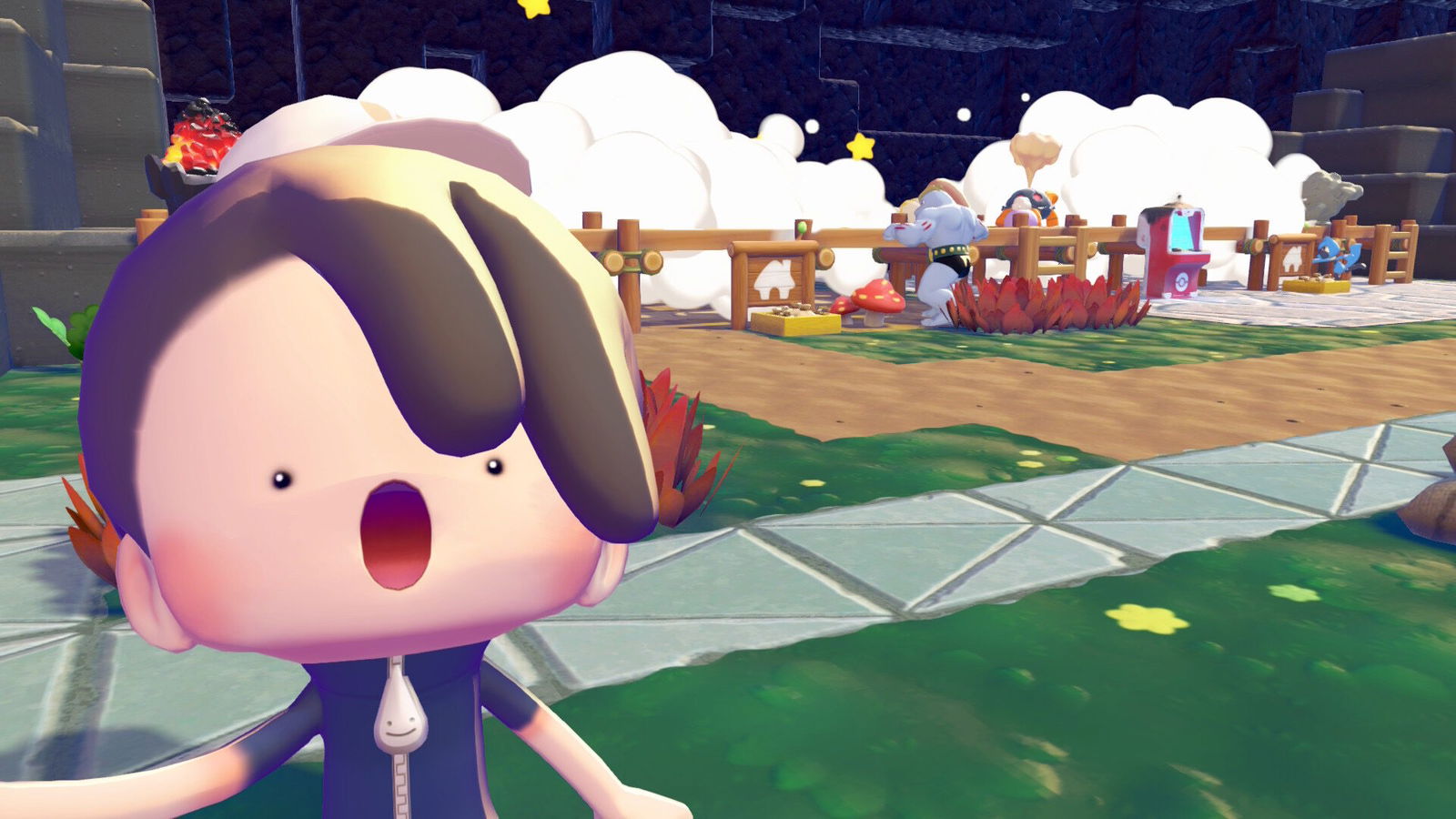


Despite how much I’ve played the main games in both Animal Crossing and Pokémon since the early/mid-2000s, I didn’t expect that both of Nintendo’s biggest time-sink franchises would meld together so well, and yet Pokémon Pokopia has just blasted off straight to the top of my list of favourite cozy games.
Historically, such crossovers can struggle to do right by both halves of their influences. Sometimes one property will wear another like an empty costume (not unlike a Mimikyu pretending to be a Pikachu) and hope that the sheer force of nostalgia will sell copies. However, it’s readily apparent that Pokémon Pokopia is not another soulless cash-in, but rather a new entity that embraces both halves of its identity and finds a harmonious balance to thrive in.

The concept is somewhat unique for both franchises: you are a Ditto who awakens in a seemingly post-civilization world, where humans and Pokémon alike have vanished, and an abandoned world waits to be reclaimed. You’re not a human starting life in a new city, or a 10-year-old shoved out the door to go on an adventure unaccompanied; you’re a shapeshifting Pokémon who takes on the form of their missing, beloved trainer.
(Before going further, it’s worth noting that while the concept of a postapocalyptic setting may seem grim for a game series whose key demographic is grade schoolers, the tone is still delightfully bright in keeping with both Animal Crossing and Pokémon. You find mementos of people’s former lives and restore dilapidated or destroyed buildings, uncovering along the way evidence of obvious climate disasters and humanity’s attempts to avoid them, but it never feels heavy. Quite the opposite, actually—so parents need not worry on this front.)
“No matter the time of day, Pokémon Pokopia offered plenty of other frontiers to explore when the usual cozy game chores were done.”
Pokémon Pokopia‘s first hour or so is spent teaching the ropes of rebuilding the world and bringing back other Pokémon. Ditto quickly develops a simple, effective toolset for manipulating the environment by copying the moves of other creatures they encounter, like Squirtle’s Water Gun, which waters soil or crops, or Bulbasaur’s Leafage, which makes new grass sprout. These skills can be used to create Habitats, which entice specific Pokémon.
This is the core of Pokémon Pokopia‘s hybrid playstyle: you “catch ’em all” by manipulating the environment like any number of cozy games on the market today. It’s a seamless system that combines the best of both franchises. You get the thrill of filling your Pokédex and interacting with other Pokémon (in a way that’s charmingly reminiscent of the Mystery Dungeon spin-offs), while building your town/world up with all the bells and whistles of cozy life-sims, like farming, mining, crafting, cooking, and so on.

Omega Force opted for a real-time system, so like many in the genre, Pokémon Pokopia‘s in-game world reflects the time in the outside world. The lighting changes accordingly, and certain Pokémon only appear at certain times of day. Usually, this format makes for a game that’s better in short bursts, like Animal Crossing—there are only so many things you can do in one day, unless you dig deep into a customization or redecoration project.
However, I did not find that to be the case here. No matter the time of day, Pokémon Pokopia offered plenty of other frontiers to explore when the usual cozy game chores were done. The land must be cleaned up, rebuilt, and reinhabited with Pokémon, and that’s just the start of Ditto’s tasks.
This mission literally extends to “other frontiers” as well, as the game offers a small handful of sandbox environments beyond the starting area, each with unique ecosystem variants, themes, and quests. For example, while the simplest Habitat to make is a cluster of four grassy squares, each area’s version of it attracts different Pokémon—but the variants go quite a bit further, with specialized Habitats for the oceanside area and the mountainous region.

Interacting with other Pokémon feels like a combination of the Mystery Dungeon games and Animal Crossing‘s Villagers, where you can choose their individual dwellings, socialize, and otherwise provide for their needs. Each day brings new requests from your neighbours, which will help improve their comfort level and, in turn, the overall Environment of each region. Improving the Environment then expands the options available for crafting, shopping, and other effects, enabling you to better cater to the people’s requests.
Thankfully, the creatures’ dialogue is refreshingly natural, for the most part, and feels more unique than the eight Villager types in Animal Crossing: New Horizons. After playing for a while, you can start to discern certain personality types by the way Pokémon share speech patterns, but overall, the Pokémon-specific conversations helped keep the game from getting stale in this regard, even after a few days of extensive play.
“Pokémon Pokopia does a stellar job of including some tried-and-true traditions in novel ways that suit this new genre and setting.”
Along the way, Pokémon Pokopia retains enough of the feel of a traditional main game journey, even if you aren’t battling or getting Gym Badges. Filling in the Pokédex is refreshingly fun with the introduction of its new counterpart, the Habitat Dex—and the list of Pokémon included is vast and pleasantly balanced across generations. Naturally, a few of my favourites don’t appear to be included, since it would be impossible to please everyone in this department without ballooning the game’s development time, but that just makes it all the better when you do stumble upon a personal favourite.
Some of my favourite discoveries were the clear allusions to the rest of the series. Pokémon Pokopia does a stellar job of including some tried-and-true traditions in novel ways that suit this new genre and setting. I wouldn’t spoil these if I could, as it was a genuine delight to stumble upon some of these secrets, and I highly recommend just diving in as blind as possible at first to see where the current takes you. (Just keep your eyes and ears open.)

Ditto’s versatile abilities make all of this possible, and for a shapeless blob masquerading as a human, it’s remarkable how smoothly Pokémon Pokopia plays. In a genre where you have to shape worlds by hand, ease of use and precise controls are critical; fortunately, the engine here is pretty robust. Ditto has a couple of traversal abilities that can be unlocked by helping certain Pokémon, like the ability to hop instead of climbing up over single blocks. Each addition suitably expands the world and refines exploration, feeling like a true reward.
The most precarious precipice of the gameplay engine is targeting. Depending on the currently equipped ability or the objects nearby, squares Ditto can interact with are highlighted with a subtle dotted outline—a cross-shape for Water Gun, a couple of squares for Rock Smash, depending on where you’re pointing, and so on. By and large, the game’s engine handles this pretty well; carefully finesse the camera and Ditto’s position, and it’s fairly easy to manipulate the world in three dimensions.
My only (slight and subjective) hang-up in this department is the size of Water Gun’s cursor in contrast to the world. Levels are largely composed of dried-out, barren land, and depending on the climate you’re trying to foster, this means splashing a lot of tiles… one 5-square cluster at a time. There’s a way to temporarily improve this range, but it’s harder to aim, so it’s almost better to keep going the usual way. It would be nice to toggle different aiming patterns or something, to make the most efficient use of time. Or you can just leave areas barren until you need to spruce them up, conversely.

On the other hand, shaping the world is remarkably easier and more intuitive than Animal Crossing New Horizons. Nintendo’s reigning life-sim champion recently added the ability to lock the player’s perspective with the ZL button for easier placement and tool operation; Pokémon Pokopia has this from the start, along with a smoother interface and fewer restrictions. (Animal Crossing‘s permits and limits exist for valid reasons, but it’s still liberating to cut free from them, and I hope the next game in that franchise is as smooth as this.)
Another small flaw in Pokémon Pokopia comes from cozy games’ biggest bugbear: pacing. Building structures requires rounding up the required resources and a team of Pokémon to assist, then a period of time for the work to be completed. A small hut takes about twenty minutes, while you’ll need to wait until the next day for certain critical structures in each level. All fair play for the genre so far, right?
Meanwhile, certain housing structures also make you wait for the next day, which would be fair if they were accordingly spacious when completed. However, after waiting about twelve hours for a larger house to be built, I found it was stylishly ready-made but also restrictively cramped inside. I would’ve been better served in creating several smaller residences, or attempting to handcraft a similar structure.

Nonetheless, waiting for a timer has never felt this inconsequential. After almost a week in Pokémon Pokopia, I still feel like I have several worlds left to conquer. Even while carrying through at a good clip for the purposes of this review, I was still enticed by a plethora of charming side quests, or even just exploring and terraforming for the heck of it. This is definitely the kind of sandbox that I could easily become lost in.
And that’s not even including the multiplayer portion, which adds a whole new dimension to the game, but was unfortunately not feasible during the review period. Based on the hands-on preview I attended and a brief poke around the multiplayer-specific content, this mode seems every bit as robust as the main game, and playing both portions should be mutually beneficial.
I can’t wait to keep discovering what else lies around the corner in Pokémon Pokopia—and seeing what others can create with its Minecraft-level of creative tools. This is one new horizon that fans of either Pokémon or cozy games should definitely explore, old or young.