


Despite only being ten years old, it’s bizarre to think that Tales of Berseria is only the second brand-new Tales game we’ve gotten in the last decade. While Arise certainly found success, it’s not unreasonable to say Tales has struggled to find its footing in the modern age, even as other major RPG franchises, like Persona, have thrived.
But revisiting Tales of Berseria, it becomes even stranger how the franchise has languished. That’s largely because Berseria is simply an incredible RPG: a delightfully lovable cast of rogues, a bizarrely complex combat system, a gorgeous art style, and a deliciously dark narrative, especially for Tales. There are still some lingering problems, like a fair share of sluggish pacing, but this remastered version of Berseria makes an already great RPG play more smoothly than ever. Even if I still have a little harder time justifying this specific remaster’s existence, considering you can quite literally, at this moment, just go buy the original PS4 version on your PS5.

Tales of Berseria, like most entries, is mostly disconnected from the rest of the franchise. I say mostly because it’s technically a prequel to Tales of Zestiria, taking place 1000 years prior – but those story links are tenuous at best. The game takes place in the Holy Midgand Empire, a powerful religious kingdom that rules over a massive archipelago continent. Humans live in the Empire alongside supernatural spirits known as Malakhim, but a disease called Daemonblight is causing people to lose their humanity and transform into monsters.
“Tales of Berseria isn’t a game that’s afraid to really go places with its story, and hold a mirror up to both its characters and the player themselves.”
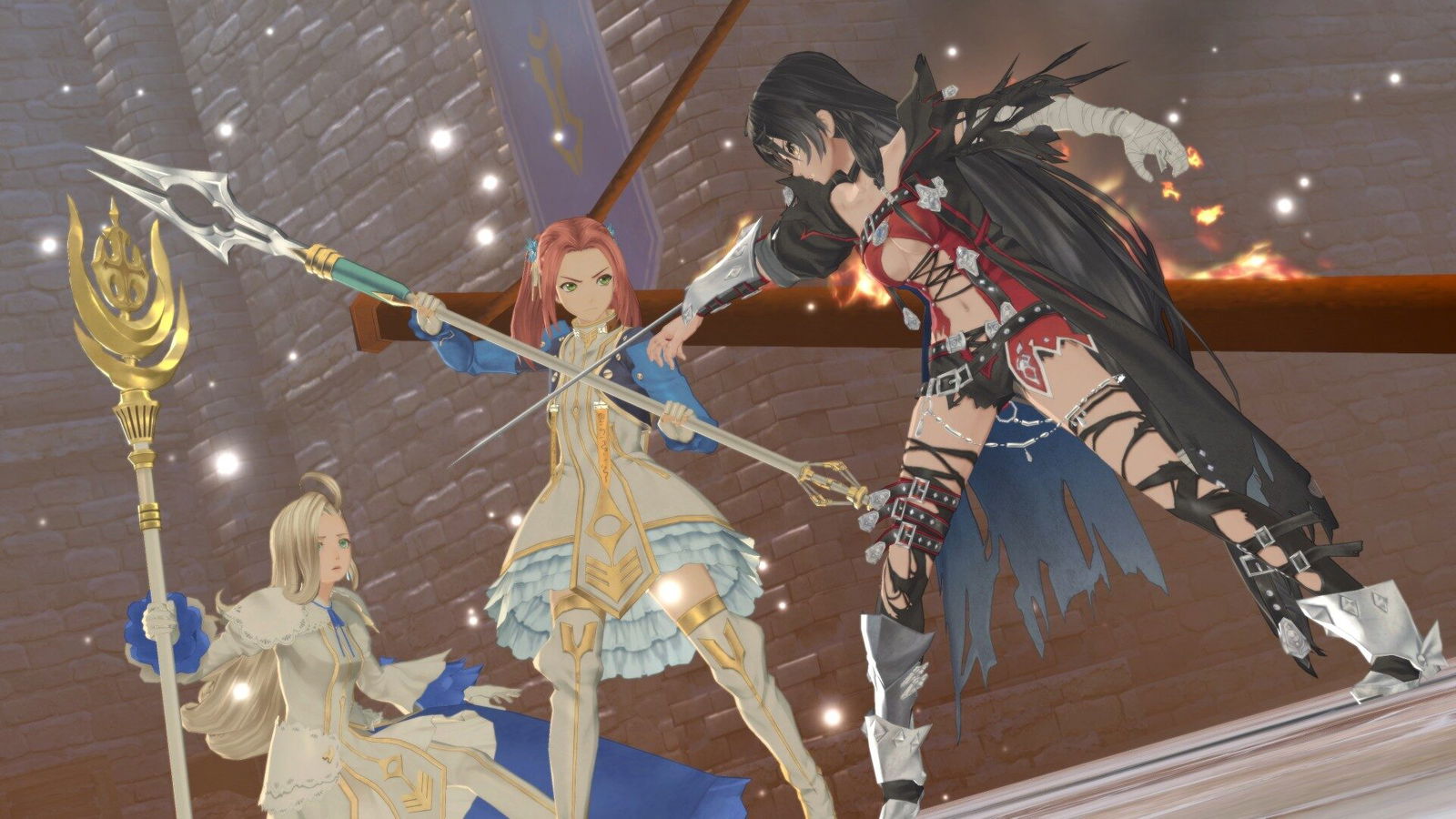
You play as a young girl named Velvet Crowe, growing up in a quaint little village with her brother Laphicet and brother-in-law Artorius. But when something called the Scarlet Night hits the village, tragedy strikes, her brother is murdered by Artorius, and Velvet herself is transformed into a Daemon and locked away in a tower for three years. What follows is a saga that sees Velvet gather a ragtag crew of “villains” to take down the power-hungry forces of the church that pull the strings of the world.
One of Tales of Berseria’s biggest surprises is just how complex and ambitious its narrative really is – a sweeping tale filled with politics, religious dogma, and deep character growth. At its core, Berseria is a revenge plot, but partway through it, fascinatingly, and in Tales fashion, turn that entire format on its head – diving deep into the psyche of Velvet, how her focus on vengeance has moulded her, and what salvation for that kind of person might look like. Tales of Berseria isn’t a game that’s afraid to really go places with its story, and hold a mirror up to both its characters and the player themselves.
And while Tales of Berseria’s narrative sings in its thematic ambition, it does occasionally get bogged down by shaky pacing and a lot of forcing the player to backtrack. It can lead to an experience that feels uneven in the middle, then picks up speed and barrels to the end. And uniquely, that sense of unevenness also applies to the game’s combat.
“Tales of Berseria sports one of the most complex combat systems of the entire franchise.”
Tales of Berseria sports one of the most complex combat systems of the entire franchise, letting you equip a set of combos (or artes) to each one of the face buttons. There are no tech points (TP) dictating everything, but rather a soul gauge that increases and decreases based on the actions you take in battle. It’s overwhelming at first and can feel a bit rote, but Tales of Berseria layers in new elements and wrinkles to combat consistently – right up until the final act. You’ll quite literally be getting new tutorials 50 hours in. But for anyone who loves deep and crunchy systems, there’s a wonderful amount of customization for each character and the party as a whole.
But aside from those two pillars, the major question with Tales of Berseria is how it functions as a remaster. And luckily, the answer is quite well. There are dozens of small tweaks and changes that make the game feel much more concise, along with a nice visual upgrade. I mentioned there’s a lot of backtracking, and thankfully, this is mitigated by the character’s movement speed being boosted by 20 percent across the board. That’s on top of objective markers, new markers for sub-events, the ability to reveal the full map, being able to toggle enemy encounters, and more.

The quality-of-life elements are just as comprehensive as the last couple of Tales remasters – and just like with those games, I can’t deny that they feel genuinely meaningful. And perhaps more importantly, most of them are options that you can turn off if you want that pure experience. This version also includes every piece of cosmetic and item DLC released for Berseria.
I can’t deny that older Tales games are more deserving of the remaster treatment than Berseria. But alongside that, I also can’t deny that this is the best version of Tales of Berseria that you can play.
The inherent issues of Berseria are still there, surely, but it’s yet another reminder of the heights Tales can hit when the series is at its very best – making each system and narrative beat work in concert.