



World of Warcraft, the cultural phenomenon that continues to shape and impact the genre it popularized, continues to strive forward, aiming to refine and enrich the world of Azeroth with its latest expansion, World of Warcraft: Midnight. The eleventh expansion in the series, and second of the Worldsoul Saga, Midnight takes many of the elements that made its predecessor great and continues to refine that experience.
In 2024, with the release of World of Warcraft: The War Within, I noted that it felt like War Within was a return to form, finally coming back to what makes World of Warcraft great: amazing narrative, player choice and a mysterious and vast world to explore. WoW: Midnight, at its core, simply improves this overall experience. While there are some wonderful new features and mechanics introduced, such as housing and the Prey system, it’s the continual process of refining what makes World of Warcraft great, and it is Midnight’s greatest strength.

Continuing the narrative after the events of The War Within, World of Warcraft: Midnight wastes no time pulling characters back into the action. Thankfully, if it has been a moment since you’ve played, Blizzard provides a great “story so far” cinematic to bring players up to speed. Admittedly, after finishing the initial campaign from The War Within, I had missed a few story patches and was thankful for the refresh.
Narratively, the story is paced fairly well, offering some great beats, specifically adding new depth and insight to some historical moments in Warcraft’s history. As a long-time player of the series, with my first deep dive into the world of Azeroth being Orcs and Humans, with far too many hours spent playing through and eventually building my own maps in Tides of Darkness and Beyond the Dark Portal, I appreciate these moments that pull from the deep and rich lore available.
“Continuing the narrative after the events of The War Within, World of Warcraft: Midnight wastes no time pulling characters back into the action.”
Its a beautiful blending of the new and established, bringing richer depth to an already deep and rich narrative. This theme doesn’t simply carry through the narrative either, as some of my favourite zones from The Burning Crusade, namely Silvermoon City and Eversong Woods, have seen a significant overhaul, with the new level design progressing the narrative of World of Warcraft visually. I have found myself quite frequently slowing down to take it all in.

Silvermoon City, especially, has seen an absolutely beautiful overhaul to represent the Blood Elves’ restoration of their once, and now again, great city. Every detail of the zone has been painstakingly reimagined, blending what was with this new revitalization. It’s beautiful to experience as a new player, I have no doubt, but as a veteran of the series, it feels like a love letter from Blizzard to players.
“WoW: Midnight takes what The War Within made great and makes it even better.”
While the restoration and expansion of these zones is impressive its the introduction of Harandar, Voidstorm and Zul’Aman that truly showcase Blizzard’s developer pedigree. Each zone offers a unique, compelling area to explore, with the zone itself helping tell the narrative through visual expression. While each is unique, each also pays homage to existing areas of the world, once again blending the old with the new to create both a sense of familiarity and wonder, inviting players to explore.
Levelling and pacing are also well balanced with this expansion, a feature that feels slightly refined since The War Within. Simply running the campaign story will see your character reach 87 or so, with the last couple of levels easily reached by circling back and running some side quests or dungeon runs. The run from 80-90 in World of Warcraft: Midnight never feels like a slog, thankfully, much of which I attribute to both the campaign’s pacing as well as its weaving through World of Warcraft’s various styles of play.

Thanks to the introduction of Follower dungeons and Delves in The War Within, the story can take you through all of these modes of play without waiting for queues or groups. For solo players, the campaign can be experienced without ever needing to group up. For those looking for group play, Blizzard has fine-tuned the grouping experience, providing great scaling and ease of access for players at different levels and points in the story.
Speaking of dungeons and delves, once again, WoW: Midnight takes what The War Within made great and makes it even better. Devles introduces a new companion for players to develop. Additionally, level design, puzzle mechanics and boss encounters feel more engaging and complex, offering new challenges.
The dungeons I’ve experienced thus far have also been a highlight in Midnight. Seeing areas revisited, such as Magister’s Terrace, has been a real treat, while Murder’s Row and Windrunner Spire offer that aforementioned blend of old and new. I’ve also appreciated the ongoing narrative that is told throughout the dungeon run that provides more context and insight. While this isn’t a new mechanic for World of Warcraft, it does feel more robust and is exceptionally well delivered.

While there are still a few more to test, each dungeon I’ve run feels well laid out and offers some great boss mechanics, with a shout-out to the final boss in Magister’s Terrace. It has forced my guild to actually learn and practice proper positioning, timing and coordination for fights, as opposed to simply standing in the fire and healing through it. In some ways, it harkens back to early expansions where boss encounters felt more calculated and required more skill to engage.
A new gameplay mode introduced once at level cap is the Prey system. While I confess that I was concerned this would be a PVP-focused experience, I was pleasantly surprised that it is firmly planted in the PVE portion of the expansion. In essence, players take on contracts to hunt down named NPCs in each of the zones, completing specific tasks to slowly reveal where the NPC is in the zone.
What makes it compelling is that at any point while on a contract, the NPC can ambush you, most times while you are already engaged in combat. As a Devourer Demon Hunter who has a real active heal, it has created some tense and exciting moments of frantically DPS’ing mobs while managing the attacks from my prey. It’s a fun system that offers plenty of solid rewards to help push the gear level to the next level.

While we did see another stat squish with the prepatch for Midnight, gearing up in the expansion has been a fun experience. Blizzard has worked to provide players with multiple options for gearing up at the level cap. From World Quests to Dungeon running to Delves to the Prey System to PVP, players will have plenty of ways to push their item level up.
The Talent system hasn’t seen a major change since The War Within, which I am actually quite thankful for. As noted in that review, reintroducing a proper talent tree was a major win for Blizzard and its continued use in Midnight makes good sense. What you will see when you open your talent window is a small but powerful update to your specialization portion of the tree, which allows for future empowering of your specialization. In the case of my Devourer Demon Hunter, I was able to streamline and empower the Falling Star spell, which is an absolutely devastating AOE spell.
Interestingly, Blizzard has opted to also allow players to spend some more talents in the existing class and Hero talents. It feels very reminiscent of how Respawn Entertainment handled Jedi: Survivor after the success of Fallen Order. Instead of reinventing the wheel, as it were, they simply continued the existing system while adding new and exciting elements to it. Such is the case with the current talent system, and it works quite well.

On the note of refined systems, Crafting carries over many of the features introduced in The War Within and, once again, refines the system. While it does feel a bit less cumbersome than its previous iteration, I, at times, feel that the current state of crafting is a bit cumbersome still, especially when creeping close to the level cap for your chosen professions. Even with secondary professions, such as cooking, it gets exceptionally expensive to craft and level.
Combat is in the best shape I’ve ever experienced it. While the new single-button assistant (SBA) is interesting and I can see the appeal, isn’t something I’ve taken to. I play World of Warcraft with a Razer Naga V2 Hyperspeed and am so accustomed to this that I simply have no desire to re-train my hands for this style of play. With that being said, I’ve seen some people absolutely master this style of play and appreciate the process and results. It once again allows players to play the way they want, reducing barriers to play for gamers who might be trying World of Warcraft for the first time.
The final feature of note that was introduced in World of Warcraft: Midnight is the much-anticipated Housing system. I was fortunate enough to sit down with Toby Ragaini just before Midnight’s launch and spend some time diving into the purpose and heartbeat behind the system. At its core, according to Toby, housing was designed and introduced as a way of infusing World of Warcraft with the community elements that some great and recent systems have inadvertently stripped away.

World of Warcraft is first and foremost a community-driven experience and is best played with friends. The new housing system is built from the ground up with this mindset, and it shows. From public to private (guild-owned) neighbourhoods, players are encouraged to work together to develop and level up their neighbourhood, unlocking cool features for their community. Our guild has absolutely loved spending time levelling up our community, completing a variety of endeavours in the world as we have levelled through Midnight.
As for the housing system itself, in true Blizzard fashion, they’ve done the research, seen what players love in other games’ housing systems, and have added the Blizzard touch to the experience. The result is one of the best housing systems I’ve used. Treating the inside and outside of the house as two distinct zones, players have complete freedom inside their home to create absolutely anything. I actually saw a recreation of the Millennium Falcon at the recent Northrend Live event in Toronto, ON.
There is a lot of freedom to snap items together, build out rooms, and even piece together individual piece so of furniture to create new and unique items. The system, according to Toby, is one they are just getting started on, with some great new features already lined up for release in later patches. Using the system is fairly intuitive as well, and I’ve found myself more than once looking up at the clock and realizing it’s three in the morning, having only wanted to move a bookshelf a few feet, and ending up completely redesigning my house. It’s a lot of fun.
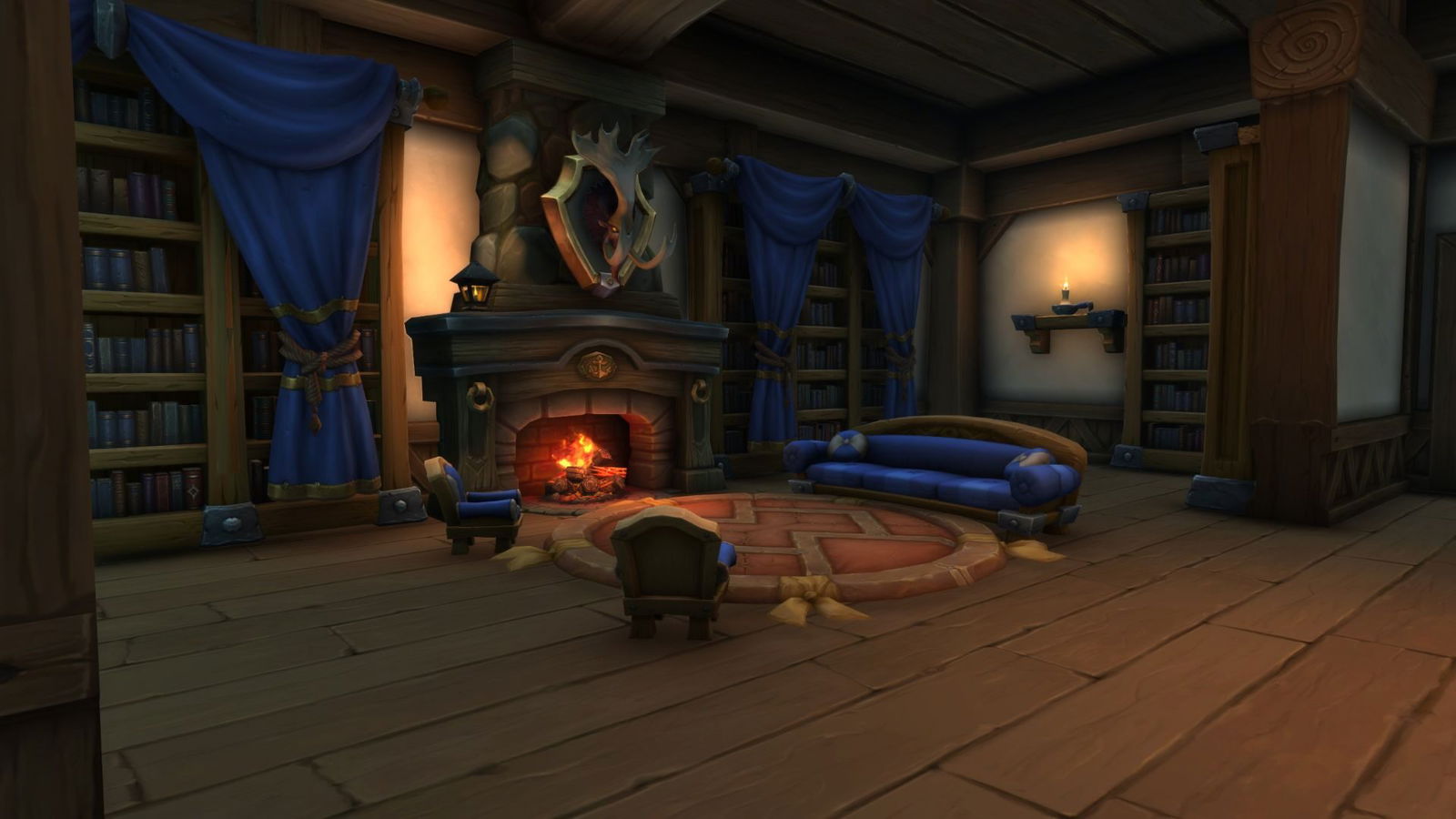

As noted, the outside space, your housing plot, is treated as a separate area and offers its own set of unique design features. The external portion of your house is broken into sections, with each section offering unique design elements such as turrets or stylized windows. The rest of the plot can also be decorated, leaving you to design as you see fit. Items can be purchased with gold and unlocked in the world through various activities and as reward providing plenty of incentive to try out the various game systems.
So much can be said about World of Warcraft: Midnight. Blizzard took everything great about The War Within and raised the bar with the release of Midnight. There really is no better time to either come back to or try out World of Warcraft. From game mechanics to narrative direction, World of Warcraft: Midnight gives me high hopes that Blizzard is on track to continue to be the dominating MMO on the market.