

Cooler Master has put customization at the center of its product line this year. Everything from AIOs to chairs is getting a modular, open‑source redesign under the FreeForm 2.0 banner. The crown jewel of that effort is the Cosmos Alpha, an ambitious new entry in the company’s flagship line of full‑tower PC cases.
Cosmos cases have been around for almost as long as I’ve been building PCs, and in that time, they’ve earned a reputation. These cases were never meant for humble builds or casual users. A Cosmos is a regal statement piece—an eccentric vault for high‑end components. They’re heavy, enormous, overbuilt, and uncompromising when it comes to compatibility.
The Cosmos Alpha takes that reputation to a new level. It is the most visually striking and mature Cosmos to date, which is notable for a quad carry-handle case with underglow. Mechanically, it is also the most versatile and easily the least practical.

On the surface, the Cosmos Alpha looks like a refined C700M. The lines are softer, the panels are mesh-covered, and the front fans have been upgraded to a pair of 200 mm SickleFlow fans. The top- and bottom-mounted frame extensions return, along with the reversible suicide-door side panels and the 4 mm thick curved tempered-glass viewing port.
With a footprint of 669 by 330 by 639 mm, support for five 360 mm radiators, 240 mm power supplies and 400 mm GPUs, the Cosmos Alpha is as large as ever. Its aluminum exoskeleton is as heavy as expected. However, it does include some notable design changes, some better than others. The styling looks familiar, but more restrained. Don’t get me wrong—it’s still the computational equivalent of a racecar bed—but on a scale of Aston Martin to Batmobile, it’s closer to the former.
Build quality remains excellent. A core tenet of the Cosmos philosophy seems to be: if it’s going to be expensive, it has to be heavy. Weighing in at a desk‑sagging 50 pounds before components, the Cosmos Alpha is exactly that. Its segmented aluminum frame is also built like a tank and is secure enough to stand on.

From the outside looking in, it’s a chassis with real gravitas. It’s sleek, understated, and looks every bit as heavy as it is. It’s impressive in every sense of the word. But I thought the same thing about the MasterFrame 500 Mesh, and where that case fell flat was its implementation of FreeForm 2.0. FreeForm 2.0 is also the weakest link in the Cosmos Alpha. The implementation is better this time around, but I’m still not a fan.
“The Cosmos Alpha is a halo product.”
The idea behind FreeForm 2.0 is that components can be completely broken down and reconfigured to meet any need. External structures can be extended or shortened. Internal scaffolding can be repositioned along a matrix of threaded holes. Fans and cooling mounts can be scaled. The PSU dock and I/O ports can be moved around. Using the open‑source CAD files, builders can even create bespoke parts to further customize their build.
The problem is, I don’t want to do any of that. If I’m paying over $400 for a chassis, I expect it to be thoughtfully designed and complete. I don’t buy the argument that FreeForm 2.0 is a platform. It’s an obvious marketing maneuver—a way to charge more for components that are cheaper to build.

My main gripe is how inelegant the interior feels. For an enthusiast‑level product, it’s not great to work with. The modular framework means preplanned cable routes and raceways are absent, and the interior is bookended by wide‑open spaces.
Like the MasterFrame 500 Mesh, the result is a sleek, modern exterior with an interior that looks like a warehouse. Cooler Master does provide some extra shrouds with the Cosmos Alpha, but it’s still crude.
It’s also a mixed bag of design decisions. The standout feature is the sliding motherboard tray, which is genuinely cool. With a few turns of a screwdriver, the motherboard can slide along rails to accommodate massive air coolers or a bank of side‑mounted AIO pumps. When pushed forward, up to three 360mm radiators—or a single 420mm unit—can be positioned behind the plate. Which is actually insane.
Cooling in general is out of this world in the Cosmos. Fully loaded, the frame can support eight 200mm fans with an additional three 120mm fans at the rear. Or ten 140mm fans, plus the same three 120s. Beyond that, there’s out‑of‑the‑box support for top‑ and bottom‑mounted 360mm radiators.
The fan and ARGB hub are fine, but it takes up valuable space on the hard‑drive mounting plate. Drive support is curiously limited for a case that’s historically been coveted as a home server. Stock, the chassis supports four 3.5‑inch drives, but only two mounts out of the box. There’s also no support for 5.25‑inch drives.
Then there are the downright weird decisions. The buttons and cover plastics feel cheap—my budget‑line GameMax Vista COC had nicer buttons. They work, but they don’t feel flagship. The bottom dust filter is an absolute pain. The filter is the floor of the case. Remove it, and the entire bottom drops out—along with any wire resting on it. If a header gets caught in the ribbing, congratulations: you’ve just jostled your wiring. Ask me how I know. To fix it, you’ll need to open the side panel and scoop everything back into place. This is not what you want for routine maintenance.

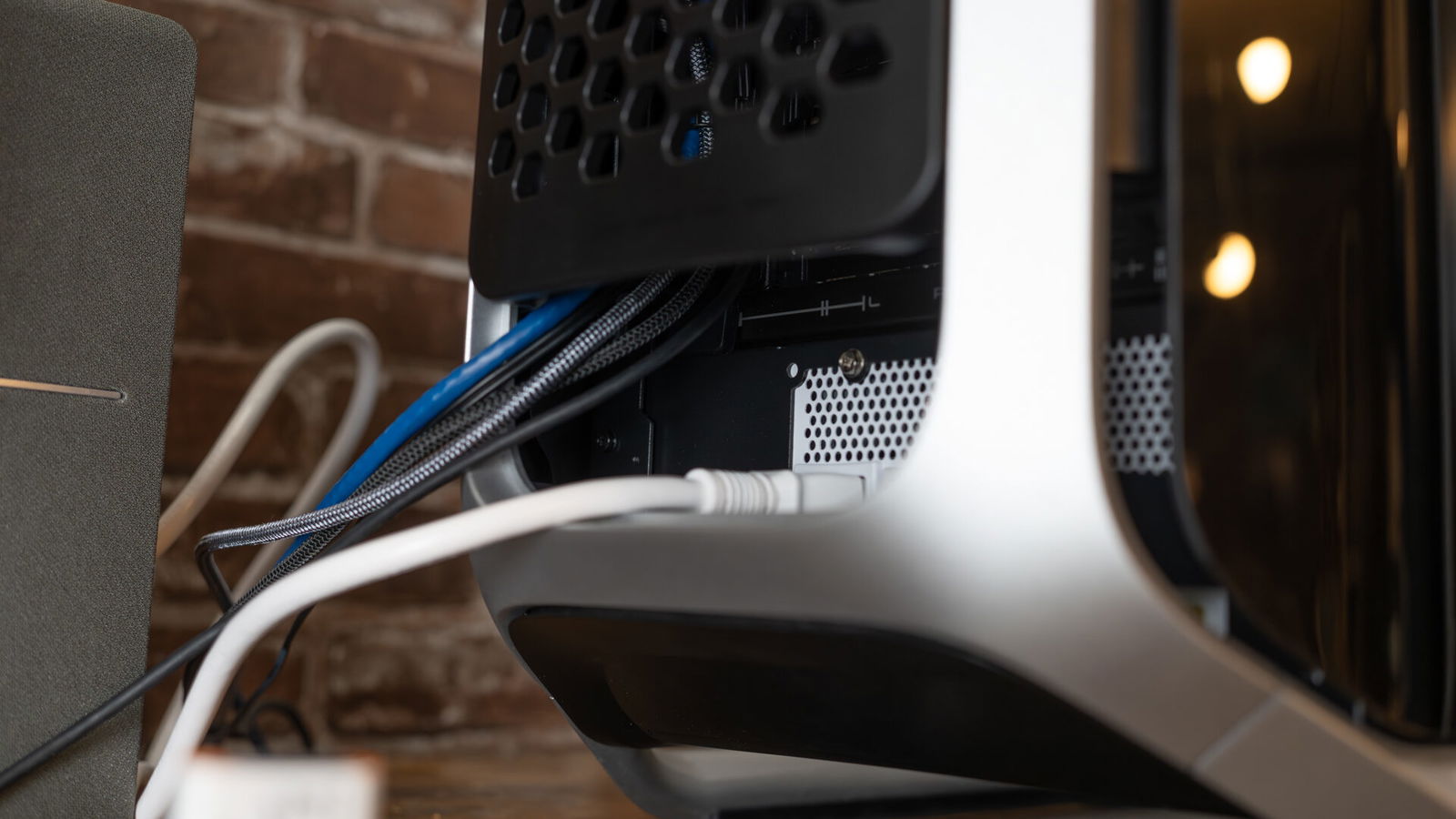
Then there’s the inverse practicality of the sliding motherboard tray: the rear fan. Because there isn’t always room for it inside, Cooler Master has placed the rear fan mounts on the outside—right where you plug everything in. To make this setup work, every cable has to be routed under a rear dust cover and secured with side‑mounted cable ties. Builder’s note: add some 90‑degree cables to your cart.
“The Cosmos Alpha will dominate any room you put it in.”
Multiple times during my builds, I found myself asking, “Was this really the best solution?” The Cosmos Alpha isn’t the first case to support E‑ATX boards and oversized GPUs; even mid‑towers can do that. It doesn’t have to be this way. If these are the trade‑offs for modularity, I’m not convinced it’s worth it—especially in an oversaturated case market where you can find an affordable solution for almost any wild build idea.
At the end of the day, the Cosmos Alpha is a halo product. It’s not a case for everyone, because it’s not supposed to be. Part of its appeal is exclusivity. Its purpose is to be an attention‑grabbing conversation piece that gets people excited about the brand. It also gives Cooler Master a chance to showcase its highest‑end processes. To that end, it’s mostly a success.

The Cosmos Alpha will dominate any room you put it in. Everyone who’s seen it in my office has had something to say. They’re talking to me, but their eyes are fixed on the computer. I can’t blame them. It’s a legitimately confounding piece of hardware—especially if you’re not expecting it.
Undoubtedly, this is a cool piece of tech. It’s also extremely hard to recommend. For most builds, it’s too unwieldy, cumbersome, and economically wasteful. But for the rare projects that actually require five radiators, sliding components, and obscene clearances, there’s nothing else like it.
For showcase builds, the Cosmos Alpha is close to perfect. Its bulletproof construction and modular framework let users reimagine and rebuild it repeatedly without worrying about wear and tear. And for public display, its sheer weight doubles as a theft deterrent.
For high‑end gaming rigs or home servers, though, the price is difficult to justify—especially if you’re only running two AIOs. For less money, you’ll find better cable management, stronger drive support, and far more practical footprints. What you won’t find is another case that looks this much like a Bugatti spaceship.
The Cosmos Alpha earns its price through novelty and spectacle. Its value depends entirely on how much you prioritize practicality.

- FLAGSHIP COSMOS DESIGN Premium curved aluminum frame with full tempered glass panels preserves the iconic COSMOS look while integrated ARGB underglow elevates your build into a true showcase
- EXTREME HARDWARE COMPATIBILITY Supports E-ATX and EEB motherboards, GPUs up to 400mm, and PSUs up to 240mm with 53mm rear cable clearance and removable dust filters