

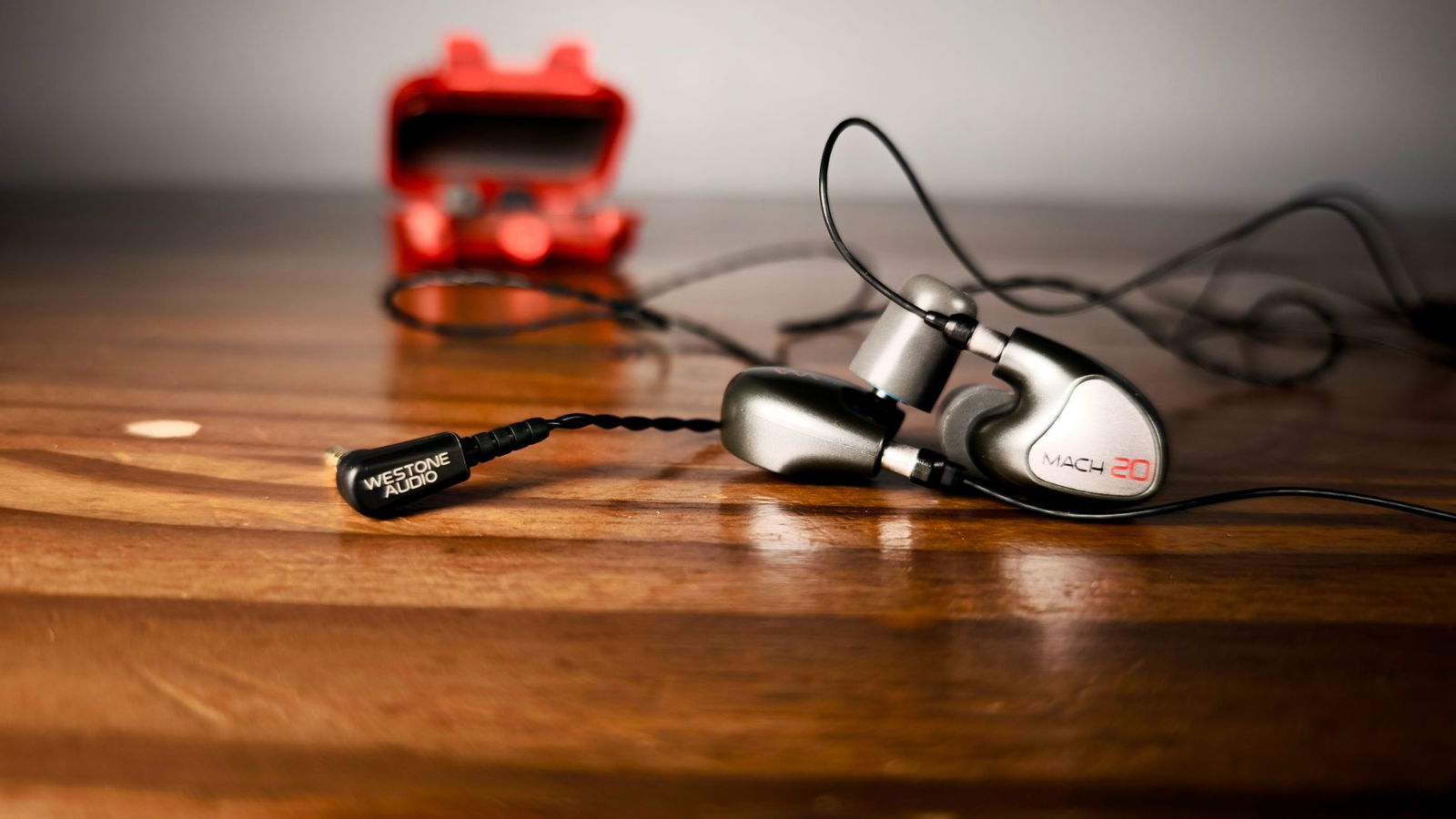
The Westone Audio MACH 20 earbuds are a professional in-ear monitoring system designed to enhance the listening experience for drummers, bass players, and anyone focused on bass performance. Featuring a balanced-armature driver configuration, the MACH 20 earbuds deliver a clear and impactful low-end soundscape while maintaining solid mids and treble. Although in-ear monitoring is a niche subset of standard in-ear headphones, the value of quality in-ear monitors cannot be overstated.
The MACH 20 earbuds are designed to accommodate a wide range of listeners, offering several variations of earbud tips. The slide-on design makes it easy to swap tips as needed, and the inclusion of five unique pairs each of silicone and foam tips supports the all-inclusive design philosophy behind the MACH 20. Regardless of ear canal size or shape, the MACH 20 aims to provide a comfortable and secure fit.
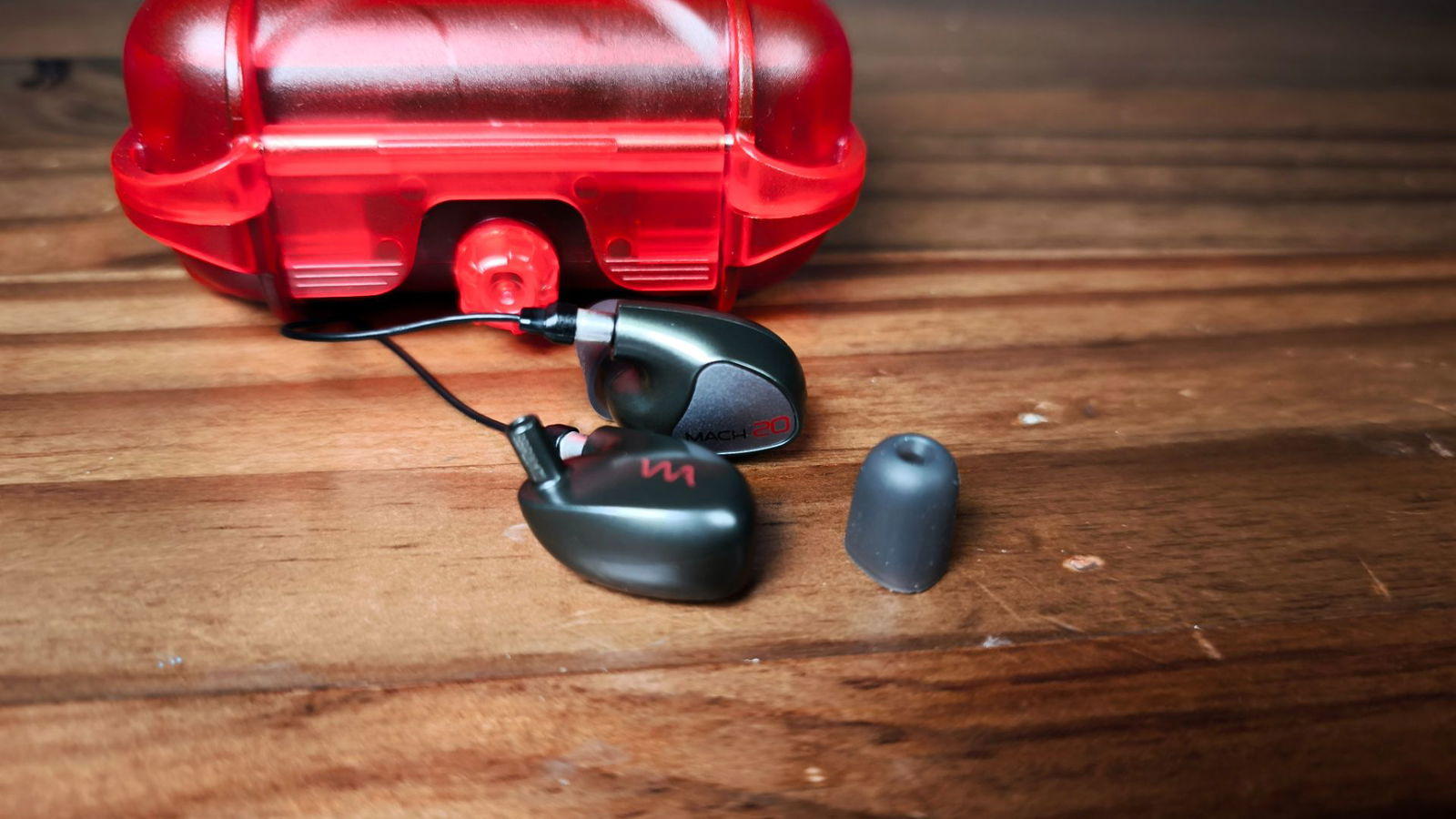
The monitors feature an ergonomic design that fits comfortably in the ear. I was impressed by how comfortable they were to wear, even after several hours. The design, combined with the previously mentioned earbud tips, makes the MACH 20 suitable for all-day wear with minimal ear fatigue. Compared to other earbuds in my office, the MACH 20 offers a noticeably lighter and more comfortable wearing experience overall.
“The ergonomic design fits comfortably in the ear, making the MACH 20 suitable for all-day wear with minimal ear fatigue.”
Westone Audio has incorporated LINUM ESTRON BaX T2 cables into the MACH 20’s construction. These ultra-lightweight and exceptionally thin cables are made from silver-plated copper, which is ideal for current transfer, resulting in a clean and precise audio experience. The cables are fully detachable, allowing for easy removal and storage when packing up the monitors. Another notable advantage observed during testing is that, when wearing the MACH 20, the cables were virtually unnoticeable against my ear.
This is a key feature of in-ear monitors, as the cable typically wraps over the ear and down the back to connect to a transmitter pack. Traditional cables can become uncomfortable during extended use in longer play sessions. By contrast, the Bax cable feels remarkably comfortable, even during prolonged sessions. A minor critique of the cable is that its thin design makes it prone to tangling when stored.
Regarding storage, Westone Audio includes a sturdy hardshell carrying case with the MACH 20, making it convenient to transport. The rubberized gasket on the lid, clamp locks, and crushproof plastic construction offer excellent protection for the monitors. The case is spacious enough to accommodate not only the monitors but also the wide variety of earbud tips included. It’s a practical accessory that simplifies transporting the MACH 20.
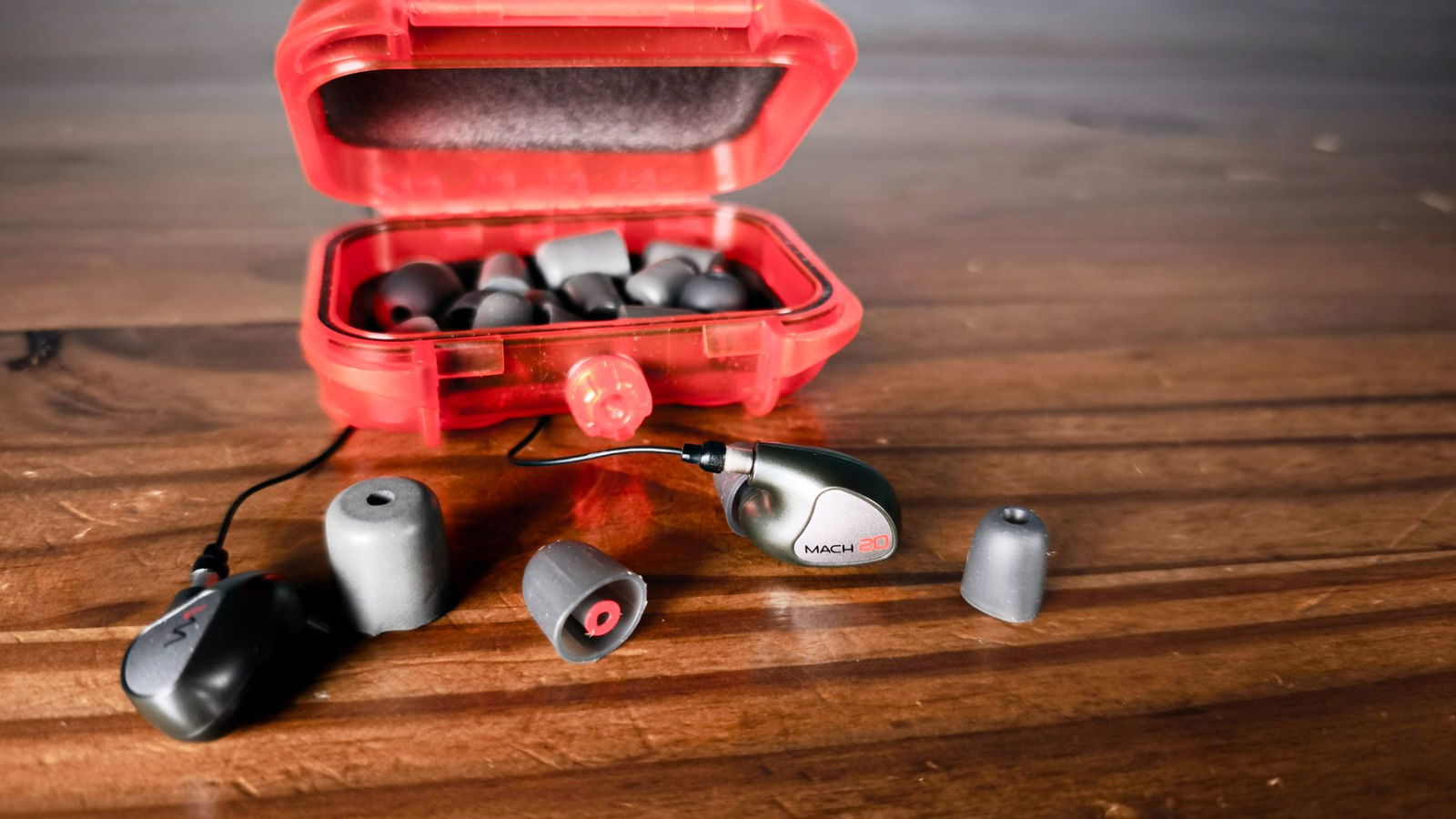
Westone Audio has chosen two single balanced-armature drivers to define the MACH 20’s audio profile. One driver is dedicated to bass frequencies, while the other handles both midrange and treble frequencies. Together, they produce a frequency response ranging from 20 Hz to 18 kHz, which is consistent with the expectations for this type and price range of in-ear monitors.
A key point to note is the use of balanced armature drivers instead of the dynamic drivers commonly found in standard earbuds. Armature drivers use an extremely small vibrating reed positioned between two magnets. When electrical current passes through the reed, it vibrates toward the magnets, translating into audible frequencies. The advantages of an armature driver include its compact size—ideal for this application—as well as its precision and accurate audio profile.
As noted earlier, the MACH 20 is designed for drummers, bass players, and anyone seeking a clean, accurate bass profile. The dedicated balanced-armature driver for low-end frequencies plays a key role in achieving this goal. It’s important to understand that the aim is not to deliver explosive, rumbling bass but rather a punchy, clear, and clean bass profile that presents the audio mix as true to the source as possible.
In this, the MACH 20 performs exceptionally well. Frequency testing revealed a low-end audio profile that was clean and precise, with no muddiness in the bass presentation. There was also no notable noise in the low-end frequencies—just clean, clear bass. Shifting to the midrange and high end, however, is where the performance becomes less impressive. The second armature driver handles both of these frequency ranges, and it shows. While the audio profile at the midrange and high end was acceptable, it lacked the same clear precision as the low end. It was by no means poor; it simply lacked the impact demonstrated in the low-end tests.
In real-world audio testing, this translates to a clean audio experience that effectively highlights the low end of a mix. The mid and high-end sound fine, and all elements in the mix are audible; however, they don’t present as well as the bass. This isn’t a criticism so much as an acknowledgement of the MACH 20’s purpose—it is built for low-end monitoring, and in that, it excels.
“The MACH 20 excels in delivering punchy, clear, and clean bass that presents the audio mix as true to the source as possible.”
One additional note on the MACH 20 concerns impedance. Impedance, in essence, refers to the power required to drive audio through the system. Most modern in-ear monitors average 20 to 40 ohms, making them low-impedance systems and ideal for belt packs.
The MACH 20, however, is rated at 96 ohms at 1 kHz. While still considered on the lower end (for comparison, some high-end audio drivers reach 600 ohms), this rating is relatively high for typical belt packs. Given that most belt packs are designed for 20 to 40 ohms, there is a potential concern that connecting the MACH 20 to a lower-powered system could result in a less-than-ideal audio experience.
During testing, I didn’t have a belt pack system on hand, but I did evaluate the MACH 20 using both my laptop, which outputs at the lower impedance range, and a powered speaker system capable of handling up to 600 ohms. There was a notable difference in volume and overall audio quality between the two systems. While the laptop could power the MACH 20, the speaker system allowed it to perform at its full potential, showcasing the extent of its design.

Like the MACH 20. While the audio profile is paramount, ensuring your device can adequately power the monitors is equally important. In the case of the MACH 20, while there is likely a valid reason for the high impedance requirements, it seems unusual given the availability of other excellent in-ear systems with lower requirements.
The Westone Audio MACH 20 earbuds are a strong choice for bass-focused monitoring. The overall design, comfort, and Bax cables reflect the quality and attention to detail Westone Audio has put into the MACH 20. While the midrange and high-end frequencies are satisfactory, the low end truly shines on these in-ear monitors. The higher-than-average impedance may be a dealbreaker for some, but despite this, the MACH 20 remains a solid option for in-ear monitoring.

- Featuring big and punchy low end, the MACH 20 professional in-ear musicians’ monitor offers a quality soundstage and listening experience meant for any audience.
- Dual balanced-armature driver system with single low, single mid/high