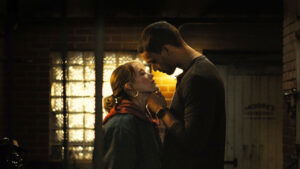


Out of all traditional Japanese performing arts, Kabuki (which literally translates to “the art of singing and dancing” in English) is likely the most recognizable to Western cultures, with its elaborate costumes, stylized emotional speech and bombastic, showy gestures. But beneath those familiar conventions are over 400 years of ritual meaning, nuance, and language that can often appear indecipherable, even to some native Japanese speakers.
Consequently, Korean director Lee Sang-il’s Kokuho, a riveting tale of friendship, rivalry, betrayal and reconciliation between two young Kabuki performers over the course of their lifetimes, won’t “crack the Kabuki code.” But at minimum, it’s an engaging narrative that will no doubt impart to audiences a better understanding of the craft as it dazzles and entertains, provided one has the endurance to sit through the entire film’s nearly three-hour runtime.

Please note that there will be some spoilers for Kokuho ahead.
Initially set in 1960’s Japan, Kokuho is a fictional historical drama centred around two young Kabuki actors in training who are fated to shake up the world of Kabuki like never before, Kikuo and Shunsuke (Toichiro Hanai and Hanai Han’ya being their given stage names respectively). Master Kabuki actor Hanai Hanjiro II insists on training 15-year-old Kikuo under his wing alongside his own son Shunsuke, the latter of course being the heir apparent to Hanjiro’s lineage: The (Kabuki) House of Tanba-ya. This is after witnessing the death of Gongorō Tachibana, Kikuo’s father and Yakuza clan patriarch, who is violently killed by a rival gang during a New Year’s gathering welcoming his troupe to Nagasaki.
Hanjiro’s act is not entirely one out of pure generosity. Having glimpsed Kikuo’s nascently raw talent as an Onnagata (i.e. a male who performs a female role in Kabuki) during an amateur performance of The Snowbound Barrier shortly before the Tachibana residence is attacked, Hanjiro sees something in Kikuo that convinces him that the young performer is destined to be a great Kabuki actor, great enough to succeed him in place of his own son, and perhaps even extraordinary enough to become Kokuho (a living Japanese National Treasure). This is despite Kikuo having a large owl tattoo on his back that he commissioned shortly before attempting to avenge his father’s murder.
A brief visit made by Hanjiro with both his son and apprentice to see his mentor, Onogawa Mangiku (an OnnagataKokuho himself), seals the deal, as there is a quality in Kikuo’s facial features that even Mangiku cannot deny. Not long after, Hanjiro elects to pair Kikuo and Shunsuke as an Onnagata duo act, not only to better assess Kikuo’s seemingly “bottomless” potential, but also as an attempt to light a more competitive fire within Shunsuke at the same time. The move is wildly popular with audiences, propelling the “To-han duo” to stardom (the word “To-han” is an abbreviation of their aforementioned stage names).

Actors Ryo Yoshizawa and Ryusei Yokohama convincingly portray the grown-up Kikuo and Shunsuke, who, despite developing a strong, brotherly bond while training together during their childhood, begin to diverge widely in their personalities as they develop into both young adults and Kabuki actors. Kikuo is studious, handsome, highly focused and absorbs his master’s teachings like a sponge, while Shunsuke, assured and confident as Hanjiro’s sole heir to the House of Tanba-ya, largely coasts on all his previous training since childhood and lives the life of a drunken playboy. It is only when a serious car accident lays out Hanjiro and he stubbornly (and quite inexplicably) taps Kikuo instead of Shunsuke to replace him in an upcoming role that the inevitable tensions between the young men begin to bubble to the surface.
I personally found the off-stage acting in Kokuho to be respectable on the whole when it comes to its ensemble cast. Few performances outside those of Yoshizawa (Kikuo), Yokohama (Shunsuke) and of course the venerable Ken Watanabe (Hanjiro) stood out, but at the very least, they were effective in conveying the story that Director Lee was aiming to tell. On stage, however, Yoshizawa and Yokohama do a masterful job of portraying the art form with their movements, speech and emotions. It’s almost inconceivable that the film’s two leads were able to put out such performances with only a year and a half of training under a real-life Kabuki master (Nakamura Ganjirō IV).
“Kokuho’s runtime was trimmed from four hours and 30 minutes down to just under three hours, but ironically, the film doesn’t feel particularly overlong.”
Beyond Kokuho’s protagonists, the stage performances themselves are the actual stars, and in that sense, the film is a virtual mix-tape sampling of classic Kabuki stage plays, including Two Lions, Wisteria Maiden, Temple Maiden, The Heron Maiden and Love Suicide, several of which are thematically tied to events occurring in the main story on a thematic level. These performances are magnificently staged and deserve to be seen and heard on the largest and finest 4K screen and audio system that is available to you.

According to the director Lee Sang-il, Kokuho’s runtime was trimmed from four hours and 30 minutes down to just under three hours, but ironically, the film doesn’t feel particularly overlong. Rather, it’s the opposite – as though it needs at least another half hour to properly flesh out some of its plot holes and details, and/or make sense of some of the characters’ strange decisions.
For instance, the entire yakuza sub-plot is egregiously handled; it’s never even hinted at who the clan attacking the New Year’s party was or why they did it, and why Kikuo, the son of their main target, and Hanjiro (who was protecting Kikuo) were among those spared. Later we see young Kikuo and fellow Yakuza youth Tokuji branding a knife and gun in an attempt to avenge Gongorō’s murder against the opposing clan’s leader, but it is never revealed how things played out, other than Kikuo admitting that he “tried… and failed,” with no apparent repercussions from either the opposing clan or the police (though it can probably be assumed that Kikuo probably spent a year in a juvenile prison).
More broadly, young Kikuo’s initial reason for taking interest in Kabuki in the first place is never even mentioned, weakening the story’s motivational stakes right out of the gate, and Hanjiro’s insistence in choosing Kikuo over Shunsuke to play his lead role in Love Suicide never adequately explained, even though it is an action that ultimately leads to serious ramifications for not only his son and his apprentice, but also for his house in general. Some elements of Kokuho just feel as though they are placed there solely because the director just wants them there, and not because they make sense.

Furthermore, while the focus of the film is on the relationship between Kikuo and Shunsuke and their exquisite stage performances, it’s disappointing that Kikuo’s yakuza origins are used merely as a plot device to suspend belief in what is already a highly unlikely scenario in the Kabuki world. Realistically speaking, regardless of how talented Kikuo might be, the elaborate owl tattoo emblazoned on Kikuo’s back, not to mention his yakuza pedigree, would all but guarantee that he would have no chance of surviving in a profession that traditionally frowns upon criminal activity and places high value on family bloodlines and succession.
Don’t get me wrong, the owl tattoo is one of the film’s central motifs, and it’s certainly memorable, but beyond providing a striking visual, the existence of the tattoo makes no sense at all to the plot. It would be near impossible for a Kabuki actor to successfully hide it for decades of his life (especially an onnagata whose upper back is exposed more often), it contradicts Kikuo’s childhood passion for the art form, and makes the notion of Hanjiro taking on Kikuo as his apprentice a completely preposterous idea. Having said that, removing the tattoo and offering a more complete, fleshed-out backstory in its place might have made for a far more convincing premise.
The above lapses in logic notwithstanding, Kokuho is absolutely a film worth watching if you’ve ever been curious about Kabuki as an art form, harbour a love for Japanese culture, and just so happen to have three hours to spare.