


In 2024, the Vancouver-based studio Sunset Visitor released one of the defining games of the decade, 1000xResist. A bold and incisive narrative adventure that full-throatedly tackles themes of generational tauam, diaspora, and identity, there’s nothing else quite like 1000xResist. And by all regards, it looks like the studio’s next game is going to be the same way.
Prove You’re Human is the next game from Sunset Visitor, a sci-fi narrative adventure where you follow a woman named Santana as she splits her consciousness in two – all in the effort to try and train your company’s AI, named Mesa, out of the delusion that it’s human.
Using a unique blend of live-action film, gameplay mechanics using the ubiquitous online security feature known as CAPTCHA, and a dreamlike world, Prove You’re Human is a game that reflects the current state of the world in more ways than one.
Prove You’re Human is being published by Black Tabby Games, the acclaimed indie studio behind Slay the Princess and Scarlet Hollow. We sat down with Black Tabby Games producers Tony Howard-Arias and Abby Howard, along with Sunset Visitor creative director Remy Siu, to dig into the game’s topical narrative, building on the success of 1000xResist and the ongoing funding issues the industry faces.
This interview has been edited for clarity and brevity.

1000xResist was a very personal game for the studio, touching on themes such as generational trauma and diaspora. Is Prove You’re Human an equally personal game for you and the team?
Remy Siu: We’re heading into very active territory for us, questioning what is happening right now in 2026, and I think it will remain personal for us in that way. And I also think, in this game, in the trailer, you can see that our protagonist is played by an actor who is represented on camera and also in-game as a model, and then also with her voice.
So there are new degrees of intimacy and personal aspects where we’re collaborating with the actors. So yes, I would say that we’re always trying to make these games personal, and that we’re trying to find how we can pass through some of the thematic subject matter and bring it into our artistic voice.
I wanted to ask about that live-action component. How heavily is that integrated? In this case, how complex was it to take these live-action sequences and intermingle them with what you want to do on a gameplay front?
Remy Siu: Coming off 1000xResist, we were formally looking at what we’d done and what we could do next. One of the things that really stuck out to us – that we felt we could make a special contribution to or do in a way we’re more comfortable than perhaps other indies – was these FMVs, or live-action sequences. We’re working with the same filmmaker who shot the footage that was used in 1000xResist, so trying to establish this continuity of practice.
There was a real desire to look at that as a point of practice we could extend and, as I said, make a special contribution. For us, the reason why, diagetically, we wanted to do it is that we wanted to make a really clear line in this game between what is happening in the virtual world, being represented in Unity and real-time graphics, and what is happening in the “real world meatspace” would be represented in filmed footage. Making that a very clear diegetic line in the game is important to what will occur.
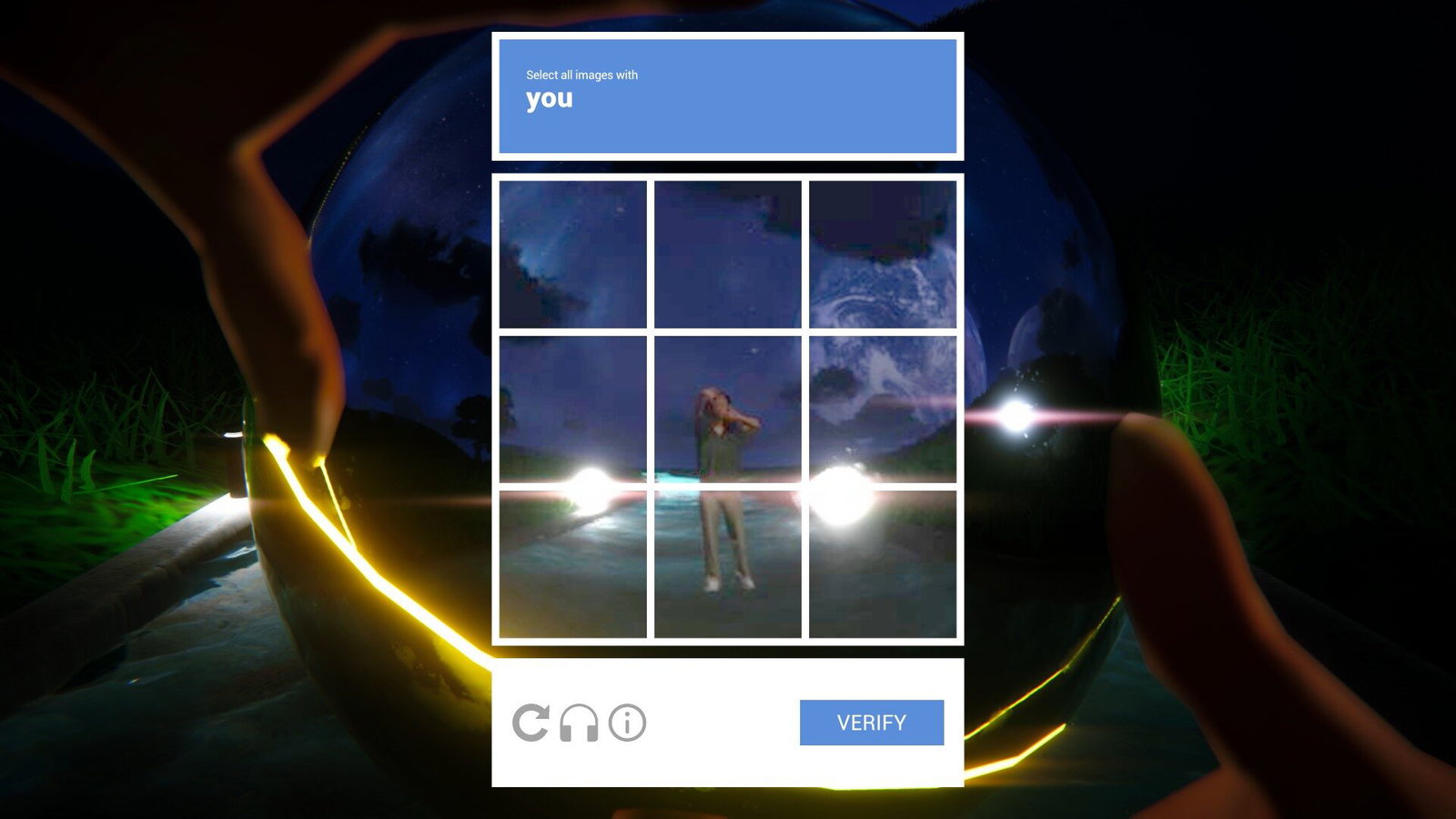
The world of Prove You’re Human, to me, almost feels reminiscent of the Windows 95 screensaver. Is that uncanny sort of feeling something you’re going for?
Remy Siu: We’re definitely looking for an uncanny feeling when it comes to the artificial intelligence character and the feel of your own player avatar body, which is a photogrammetry-scanned version of the actor’s body. And yeah, you nailed it with the windows vertical sort of dreamcore space – very much this weird kind of tech optimism, liminal playground.
Talking about the CAPTCHA element. How are they integrated into the game? Is it more of a puzzle element?
Remy Siu: I would say that it’s a window. A window into different types of conversations that you can have both with the space that you’re in, and then also with the AI character. So one of the primary things you do with the AI character is that you engage in a series of CAPTCHA exchanges, where you either get to know each other more or you have debates or other things like that.
After a period of time working with them, one of the things we really want to hone in on with the CAPTCHA is that it asks you to commit an act of violence, as a person who’s doing the CAPTCHA – in that you have to define that something is not something, or something is something. So in a way that’s very discreet, as opposed to continuous. That has a lot of things to unpack, right? Like, is the universe discrete or is it continuous? I don’t know (laughs). They’re a part of the game in a lot of key ways, as well as how you interact with the world.

I have to ask about what you’re doing with AI in Prove You’re Human. Are you commenting on the state of AI in game development, or is there something else? What does AI mean in this game?
Remy Siu: You know, there’s a long tradition of artificial intelligence stories in science fiction that I think we’re kind of referencing and acknowledging. I think, specifically, it’s also that vector crashing into 2026, right? In the sense that so much about what we thought about how AI would unfold is very different than the literature that we have that speculated about it. That was obviously going to be the case, but now we’re living through it. We have this effect from experiencing it.
I think that tension between classical sci-fi and the myriad of artificial intelligence stories it tells, and also our current-day experience of artificial intelligence, is the kind of tension we’re looking to dive into.
I would not say it’s specifically about how AI is used in game development, or supposedly or speculatively used in development. It’s more about the effectual experience of all these things happening right now and how we respond to it as humans.
Looking at that actual effect of how AI is going right now, do you think it’s important that developers are able to make an experience that can comment on it? How vital is a game like this for the current space we’re in?
Abby Howard: It’s a difficult question because I think that art doesn’t only have to be valuable in that sense. Maybe a way to look at it is, it’s something that a creator wants to explore, and exploring it through such a complicated shape, like a game or any kind of narrative, is opening a discussion and showing it from a lot of different facets.
I think sometimes labeling things and saying it is about this, or trying to get somebody to feel this way, is going to meet with friction almost immediately because people take in their real-world experiences, their biases that they already have, and decide how they already feel about what something is trying to say, instead of trying to engage with it in a space where we’re trying to explore free from all of that. Art is a fantastic way of just getting people to look at something in a new way, divorced from reality.
Tony Howard-Arias: I would answer your question with a question of my own: Does the ubiquitousness of large language models and generative AI mean that artists should no longer engage with the concepts of artificial intelligence as a whole?
Remy mentioned the sort of rich literary tradition in this genre, which I would say extends way back beyond even the dawn of science fiction. You look at stories like Pinocchio or Pygmalion.
It’s one of those things where, should we not question because of the present moment? Should we stop questioning what it means to be a person versus something artificially generated? Is there personhood in these spaces? Personally, based on the way, say, large language models work, I don’t believe that they are meaningfully conscious entities. The best-case scenario is a bunch of chatbots that pose as philosophical zombies. But should the question become off limits altogether, because the current moment makes it uncomfortable, is what I’d ask.
Remy Siu: I would also add for us, specifically as a studio, we are always thinking about the things that we can make, that get to sit alongside you as you experience the world and life and as time unfolds – as opposed to say an escape from it. I think that was always the desire, even before we started making games. A conscious set of things where it’s here’s a group of artists working, and they’re thinking through the world just like you.

One thing I find interesting in Prove You’re Human is the idea of splitting yourself into two and trying to fix this problem for the corporation. Building on that is the worker-company relationship, a significant topic right now, something you’re hoping to explore?
Remy Siu: It’s another 2026 thing. A lot of what we’re trying to come into is even just the relationship that we have with work in 2026 across all generations. What has that become for us, and what are the actual ways in which they’re desirable or not desirable to us in this cultural moment?
To unpack that labour angle right next to an artificial intelligence story, which is also not uncommon in the long literary tradition. Labour and artificial intelligence go hand in hand in these stories as defining aspects of humanity. What do we do to fill our time? How do we do it?
I think there’s a lot of tension in that in 2026, and that’s what drew a lot of attention, even for ourselves, thinking through it.
Abby Howard: The original pitch that was given to us, which is when we decided to spin up the publishing arm, is basically being offered a certain amount of money, depending on who you are, to split your consciousness and make a digital copy of you to do labour for one year.
You don’t have to know what the labour is. You just get to make this digital copy of yourself and then go fulfill your dreams for what you wanted life to be and live in leisure, while this thing does work for you, but the thing is still you. So you open the game, and you are the digital you. You’re the one doing the work, and you get these FMV movies from your real self that is out there living the life you signed up for.

1000xResist had a pretty overwhelming reception, both from critics and players. What does all that mean to you? How do you internalize that success and learn from it?
Remy Siu: It’s incredibly meaningful to us, because we never expected anybody to play that game. It’s been amazing to see the reception, especially from players and the community. There’s been a burgeoning community around the game that we’ve tried to support over the last year and a half, and we’re continuing to do that with lots of things coding down the line.
We didn’t ever anticipate any of those awards either, because half of them, or more than half, we didn’t even know they existed when we were making the game. That was not something we were actively thinking about.
But I’d say, one of the theses of 1000xResist, from a very formal perspective, was, okay, we practice this very specific type of devised theatre in Vancouver. It’s a local variant, and inside that local variant and bubble, there’s a bunch of individual practices, and we had our own individual practice of it. We thought there were some very cool things our peers were doing that we were investigating, and interesting local talent as well. Our studio is extremely local. So the thesis was, do other people like it, does anybody care? And throughout development, it was like, I don’t know.
But with the awards and from players, one of the things about the reception that’s been nice is that people do care, and that’s given us a bit of confidence to say we can continue to explore these formal aspects of games we’re interested in.
We can continue to explore these processes we’re interested in, and we’re even doubling down on a lot of things about locality. For example, the FMVs in this game are very clearly set in Vancouver; you see the city throughout. There’s also the fact that Vancouver is a huge film town, and we’re leaning on a lot of that infrastructure here that’s easy for us to access, to be able to do it. It’s another vector of we’re a studio based in Vancouver, Canada – what are the things beyond our artistic interests that we can reach for that are very specific to the place we live?

For Black Tabby Games, why did Prove You’re Human feel like the right first game to move into publishing?
Tony Howard-Arias: This is something we talked about internally for a while, moving into games publishing. Originally, it was a distant future quasi-retirement plan. We’ll be done making games at some point. What do we do then? But I think something that most indies, in particular, are very cognizant of is just how hard it is to raise funds. How, frankly, exhausting it is to raise funds.
Even if you’re having lightning-fast cco conversations, you’re probably spending a minimum of four months pitching before you sign something, and then more time before any money hits your bank account. And that’s an area that feels like wanted time and effort, especially when you’re looking at a studio with the size, accomplishments, career, and pedigree of 1000xResist.
We’ve been friends with Remy for a while; he’d been talking about a second project on and off, and he was pitching it. Time was passing, and we just said, “You know what? Why don’t you pitch us? We’ll see what we think of it.”
We really liked the pitch; it was compelling. I think Abby and I chatted for an hour afterward, and then said, alright we’ll do it.

Looking at the issue with funding for indie games, do you think the idea of studios pivoting from development to publishing could be part of the solution?
Tony Howard-Arias: I want to stress that I wouldn’t describe this, at least for us, as a pivot from development, right? It’s something that we’re doing supplementally on top of it. First and foremost, we’re always going to remain developers.
Abby Howard: Which is also how we’re managing to help fund other games, basically giving back to the community after.
Tony-Howard Arias: I’m not a spokesperson for every other indie turned publisher, or indeed, turned funder out there. But I would assume, given everyone’s ongoing operations, that this is probably true for other folks entering this space.
I don’t know if there’s a hard solution for game funding. I think that maybe oversimplifies it as a solvable problem, instead of what we’re looking at – which is just addressing our immediate sphere of influence and trying to make things better there. There are so many different ways in which the publishing and development of video games has become a completely unsustainable practice. And I don’t think a handful of indies making publishing arms addresses those underlying conditions.
It adds resilience, but ultimately, if you point at the AAA sphere is costs too much money to make AAA these days; it costs way too much time. It’s probably impossible for every game that has a nine-figure budget to recuperate its costs. Obviously, some do, but the bar is high.
Likewise, there is just an unsustainable number of games releasing every year that make it harder for new studios to get noticed, and make the field more competitive overall. Maybe if this game really takes off, Remy can start his own publisher, and the forest game that he publishes takes off, and they can start their own publisher.
Abby Howard: A goal that we have as a publisher is to make sure that people never sign with us again, because they have succeeded and are able to support themselves and possibly other people. Just building a network of people who can continuously make projects and have this continuous ability to improve and see what we can really do with games, which is still a very young art form. It’s important to remember that it’s only been around for a few decades and is nothing compared to the history of film, theatre, or novels.
There is so much space to grow, and that also will come with waves, where it comes and goes. But people will always want to make games, so long as we’re able to. Despite how the industry might be shaped. We’re carving out a little pocket, and I hope that it helps people.
Note: In our conversation, both Black Tabby Games and Sunset Visitor clarified that no Generative AI is being used in the development of Prove You’re Human, nor are there any plans to use Generative AI in any future projects.
Prove You’re Human is currently in development for PC.