
Rainbow Six Siege just launched some truly groundbreaking announcements regarding Year 11 of the popular title. Whether you’re a casual player, an esports player or even a Metal Gear Solid fan, there is something to be excited about during the next year of Rainbow Six Siege.
Ahead of the major announcement at the Six Invitational in Paris, France, CGM was not only able to pick the brains of the Ubisoft team behind Rainbow Six Seige esports, go hands-on with Metal Gear Solid’s Solid Snake, the newest Operator to join Rainbow Six Siege, see sneak peeks of what is coming to Rainbow Six Mobile’s global release, and even get a look at the new Calypso map, but we also sat down with the brand-new Creative Director, Joshua Mills, who was able to walk us through a lot of the changes coming to Year 11.
Mills gushed about the Konami collaboration, gave us some insight into how the Metal Gear Solid partnership worked, and even chatted with us about Rainbow Six Siege Year 11 changes like balancing, Rank 3.0 and the game’s new meta.
So, first off, congratulations on the new role as Creative Director of Rainbow Six Siege. So what does that mean for you now? What has changed from Game Director to Creative Director?
Joshua Mills: I mean, from the actual overlook of the game and stuff, as the Game Director, I focused on taking the vision of the Creative Director and implementing that in the gameplay features and overall gameplay experience. At this point, as the Creative Director, I’ll be kind of helping manage and direct the entire vision of all aspects of the game. This is our animes and CGIs that we see, and stuff like this, helping with every core content director on the team through all the different disciplines. So just like the unity of all that together, as well as still working with our new Game Director.
So, what does that pressure feel like?
Joshua Mills: Honestly, a live game, like Siege, it’s a different beast, and it kind of tempers you. It takes a little bit to get on that treadmill because the thing is, I joined over four years ago, and we’re getting close to five years at this point. It’s kind of like jumping on a treadmill that’s already going, right, and you’ve got to get up to speed and get kind of comfortable. But once you hit that rhythm, the pressures of it and all the different things like this, it becomes almost like a normal situation.
Because we’re shipping every three months, you get comfortable with it. And I’ve been heavily integrated in Siege for over 10 years, just playing the game, but even working with Alex Karpazis, I’ve been shadowing him for over a year, and we’ve been working together, and we work together incredibly well. So like he’s made the transition really optimal.
So we’re at the Six Invitational for Rainbow Six Siege. What do you think of the tournament so far? Did you actually get to go out and watch it? I know you’re busy here!
Joshua Mills: I didn’t get to watch as much as I would have liked. I keep looking at the screens even when I shouldn’t be, because there’s a screen right there and right there. But I did get to see the opening ceremony and this year, the chorus and the music. Did you catch that?
Every time it feeds the soul, it’s such a moment. So I was happy I got to do that. I’ll catch as much as I can.
Do you have any predictions for the weekend during the Six Invitational?
Joshua Mills: While I was happy to see the first game go to three maps—that was really good to see. I’ll say this, I’m not allowed to pick favourites. But because we’re in Paris, it would be great to see a French team on that stage.
Safe answer, but I like it. In your opinion, what makes Rainbow Six Siege a great esports title?
Joshua Mills: Oh, the intensity of the game! The thing that makes Siege just an awesome game and then even better as an esport is that you could have the best laid out strategy. You could train forever on everything that’s going on, and then the second you’re in the lobby, it changes, and then it’s like, “Well, wait, they did a setup we haven’t seen before,” or “What’s that doing there,” and then you’ve got to adapt and that’s the love of game.
Seeing that, or if someone gets a lucky spawn beat going off, the entire plan is shattered, “We gotta adapt right now.” So I think that’s it, and it’s just like when you’re playing the game, every round is different, every match is different. It’s the same thing on the stage; you just never know what’s going to happen.
Jumping over to the Rainbow Six Siege Year 11 updates, can you explain a little bit about the new balancing meta that you’re moving to?
Joshua Mills: Oh, absolutely. Back in Munich, we were talking about this update to the balancing philosophy. This is really for us to get in tune with our community on this and deliver essentially what they’re asking for and the needs there, as well as focusing on the excitement and fun of the game. If we go in and we’re able to shake the meta a little bit, all the creativity of our players comes out in droves.
They start coming up with all sorts of new patterns, all sorts of new strategies and stuff like that, and we’d love to see it. We’re even seeing it on the SI [Six Invitational] stage, because normally we don’t push updates as big as we did in 4.2 of Year 10…the most recent update, because we see Thorn on the stage like that, that’s amazing to see, and it kind of shakes everything up.
But the goal here is to make it exciting. Every update should be exciting. You shouldn’t be like, “Oh no. My Operator is now not…” No, your operator is going to be awesome. They’re going to have a good time, and we’re going to see what’s going to happen this season and what is the story of this season.

How is Rainbow Six Siege changing from Rank 2.0 to Rank 3.0?
Joshua Mills: So Rank 2.0 and 3.0, there’s a lot of learnings and a lot of different things we’ve gone through through that experiment of trying out a bunch of stuff there, but then more so, we actually, again back in Munich, we held a workshop with a bunch of key creators and community members to showcase Rank 3.0 in its earliest stages so that we could get the feedback and understand exactly how is this going to meet the needs? Is this aligning well? And then we took that back to the team, and then went back into essentially development mode and cleaned it up and made some adjustments.
Essentially, when it comes down to it, your rank is your MMR [matchmaking rating]. That’s it, no more confusing stuff, no more hidden MMR or anything like this. So what you see is what you get. If you’re gold, it’s going to be gold, and you’re going to fight within your rank. But the one thing we want to add, and this is, I think, this is really awesome, is that the rewards we used to do, so like you could get a headgear or something, but you had to get to a certain rank in order to get that.
We’re changing some of that to almost be like a seasonal progression for you. So your rank is your MMR. That’s exactly what that is. But then, as you play, you can be rewarded. So maybe you’re just starting into Siege, and you’re copper. That’s fine. We’re going to keep rewarding you for showing up and trying and practicing and putting the effort in, because ultimately that’s what really matters, and that’s the only way to climb.
The choice is being made in Rainbow Six Siege to release one Operator per season going forward. Do you think there’s ever going to be a point where Siege has too many Operators?
Joshua Mills: Yeah, there’s a lot of. Operators. But at the end of the day, I think it’ll come down to the fact that—we talked about this a little bit—depending on who you talk to, we have fridge or freezer of operator ideas, and it is extensive, like this thing just goes on for miles as far as the different ideas. So I don’t think we’re going to like run out of ideas on what we can do in the game, especially how we address the meta of an evolving, living game like Siege.
Do you think that you’re ever going to have to start removing Operators in Rainbow Six Siege?
Joshua Mills: I don’t think we’ll do that, no. Because I mean, that’s like telling you to pick your favourite child.

Literally right?
Joshua Mills: Our Operator remasters were exactly that, where Operators had fallen, essentially exhausted their balancing levers, and stuff like this. And they weren’t being played, and they didn’t fit into the game anymore for multiple reasons. But instead of removing them, we invested in them to bring them back on, and every one of our remasters has been on the stage, which is freaking awesome.
So, is there a big difference between which Operators in Rainbow Six Siege are the most popular among esports players, more casual players, and as a player yourself?
Joshua Mills: So, there’s definitely a difference, because depending on where you are in your journey in Siege, you’re going to have very different metas coming up. You’re going to be playing essentially different games. But at the pro level, they’ll be going after lots of utility, lots of functionality and versatility. At different ranks, you’ll see less of that. Like some Operators are less popular in lower ranks when it comes to. Myself, do you mean more like where’s my preference?
Yes, which Rainbow Six Siege Operators do you prefer to play?
Joshua Mills: So the funny part about me is I don’t play meta usually because I play fantasy. And that’s the thing that kind of locks me in. So if I think an Operator is cool just because they’re cool, I’m going to play them regardless. I will try to help the team, of course, I’m going to try to serve my team and stuff like this. But at the end of the day, if, let’s say, this entry Operator is statistically performing better than this entry operator, but I like the character of this one more, I’m we’re going to play this one.
I’ve always loved Thermite. I’m not going to swear on the thing, but he’s got a perfect line that I love that he says, so I absolutely love Thermite. Smoke has always been a fan favourite of mine, too, on defence. But I have been changing a little bit more, going back into Maestro and Echo. I’m going to rant for a second…

That’s okay, please do!
Joshua Mills: Our team, like inside the studio, we have this thing called STL. It’s a tournament amongst the developers of Siege, and we can compete against each other, and Danny, who is walking by right now, he was in SDL as well. But anyway, we go ahead, and we compete against each other, and this is where I got to pull out some sick Echo plays, and I loved it.
Because again, they didn’t expect it. They had read our team and understood what we had been doing the whole season, and we didn’t play the Echo. We waited until the finale to start bowling them out, and then they had to scramble, and it was great.
When it comes to Metal Gear Solid’s Solid Snake coming to Rainbow Six Siege as an Operator, as a developer and then as a player, what do you think about it all?
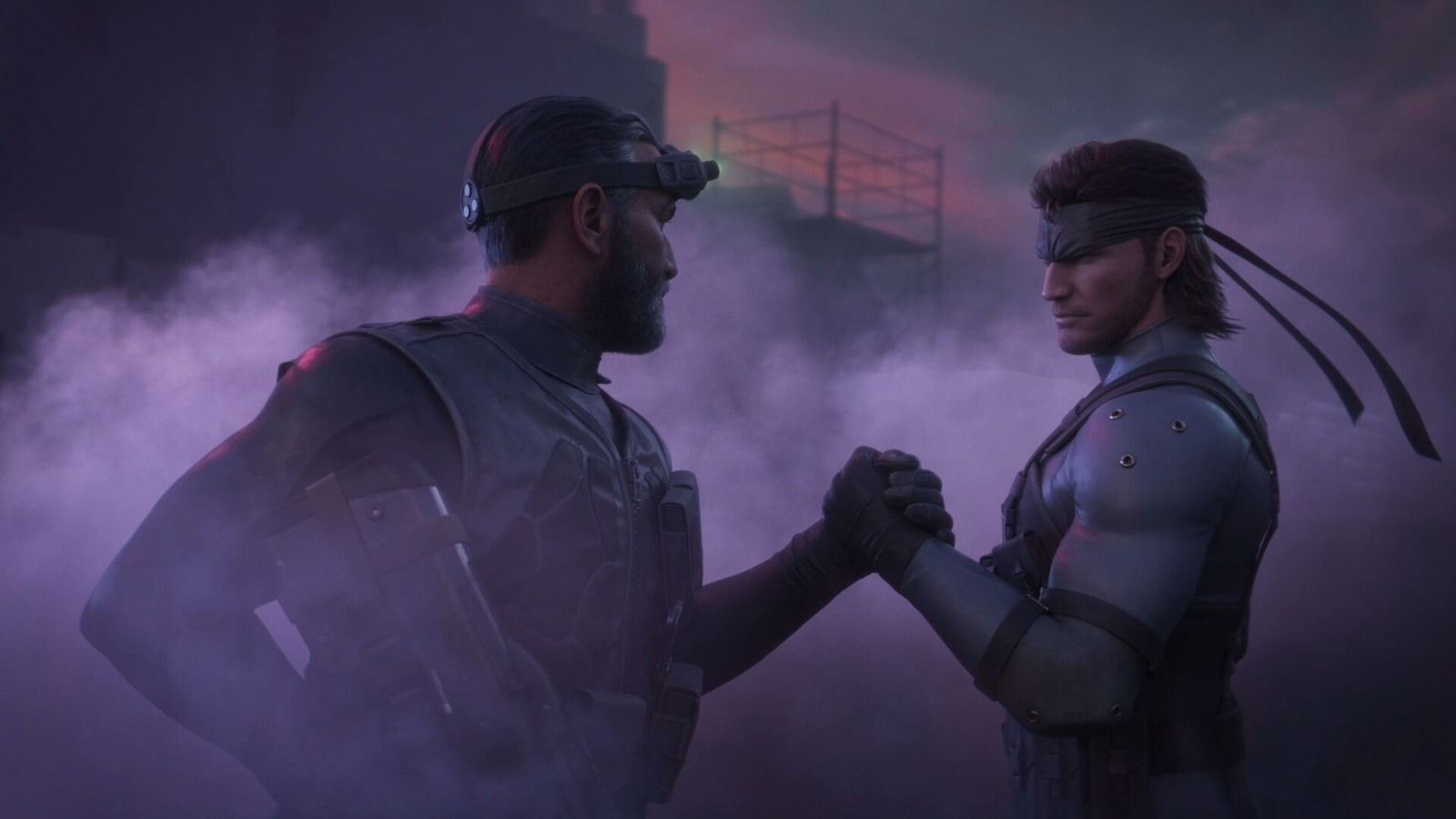
Joshua Mills: Solid Snake is incredible. Just as a developer, this is a once-in-a-lifetime opportunity. And I can’t stress that enough. It’s beyond Snake as well. It’s the fact that we can have Snake and Sam together. It’s like the most nerdy dream ever possible, and it’s amazing.
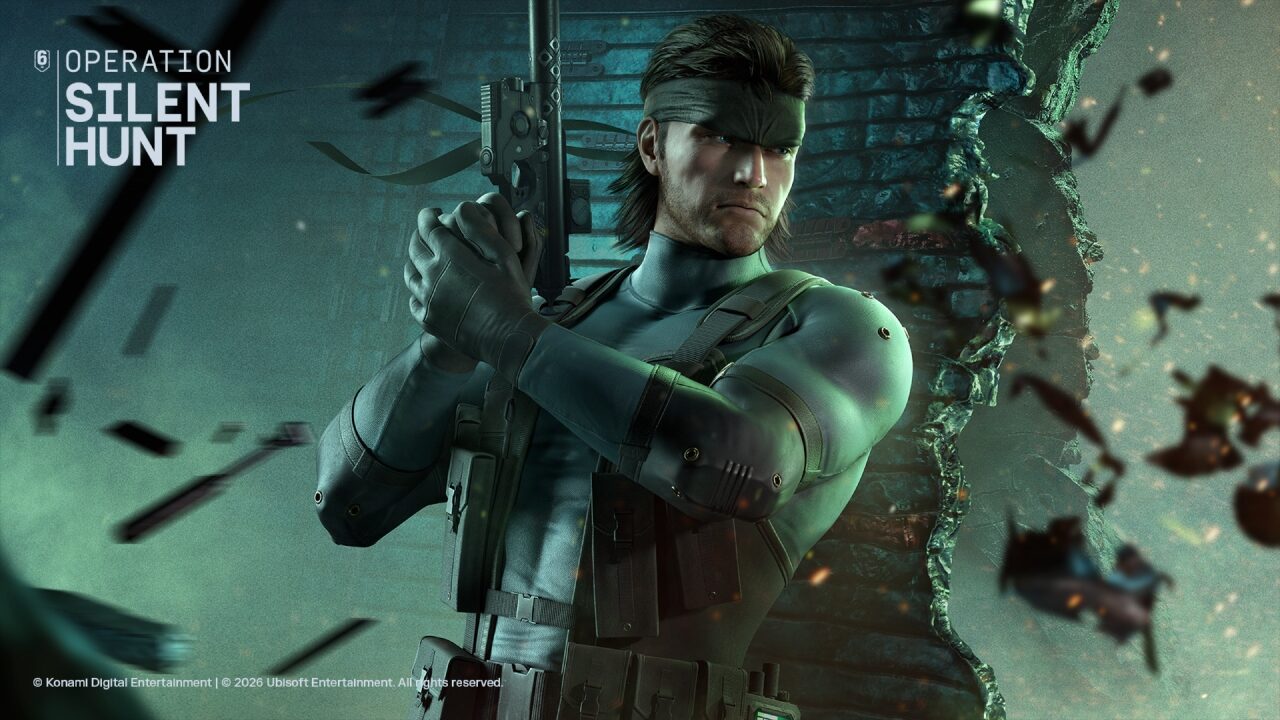
So, as a huge fan of the franchise—but a lot of people on the team are huge fans of the franchise—this has been a dream collaboration for us. As a player in the game and seeing how he fits into Siege, I’m super excited about that because he kind of comes in as an in-game leader sort of Operator. Amazing at getting intel, helping people get into the building, but then being essentially that infiltration specialist that he is and sneaking up on you and making that jump on the roamers. It’s awesome.

How did that partnership between Konami and Ubisoft come to be, then, especially getting Snake and Sam on screen together?
Joshua Mills: So at the end of the day, whenever it was brought up to me, Alex sat me down and was like, “Hey, so Snake in Siege.” I was like, “What?” And that was two years ago.
And then, essentially about a year and a half ago, everything was all green that we were good to go. And there was passion on essentially both sides. Konami was super excited. They saw the natural fit, how it could organically work into Siege. And then we were off to the races.
They provided us a ridiculous amount of resources to be able to build from this and pull from this. Of course, we’re nerds. We had tons of resources because we love the franchise too. And then this obsession for us all to get it right and be like, serve the character justice.
At the end of the day, now, it is our kind of reimagining of Solid Snake in the Rainbow Six universe, but every detail counted, every little thing that had to go into it, we were all being perfectionists, and I think that’s going to show when people get their hands on it.
So why was Metal Gear Solid’s Solid Snake the right choice to bring somebody from the outside into Rainbow Six Siege?
Joshua Mills: Oh, I think it kind of feels already a natural fit because of his elite prowess, of what he does and how good he is at what he does. It fits the exact criteria to be a Rainbow Operator, so making that connection was very natural. And it just, again, match made in heaven. It had to happen.

Can you tell us a little bit about Solid Snake’s loadout in Rainbow Six Siege and how it was settled on by your team and Konami, if they were involved?
Joshua Mills: So the loadout, like again, because every detail matters. We definitely were looking at, “Okay, what makes the most sense?” And immediately when you look at it, you’re like, “Okay, an F2 100% makes sense. The PMR90A2, that weapon is as well really reminiscent of a kit that the Snake would be running.
And then lastly, the TACIT .45. I mean, he has to have a wetworks pistol. And we gave him one. And there’s a small little detail on it, just as a fun thing, because we obviously had to keep this collaboration under wraps for a long time.
So the codename for Solid Snake internally was Diamond. And on the TACIT .45, you’ll actually see diamonds on it, etched into it, because we got so used to calling him that. And we were doing rehearsals for the panel, and we actually kept on saying the wrong name and kept on saying Diamond.
Was there anything that was considered for Solid Snake’s Rainbow Six Siege loadout that didn’t make it that you can tell us about?
Joshua Mills: Okay, so we went a little crazy on this. Normally, we would only issue one new weapon. That was one of the things we were going to do, which was the TACIT .45. But the reason we released the PMR the previous season, in Year 10, Season 4, was because we knew we wanted to give it to him. So we kind of cheated by getting two weapons on him.

Do you think this is going to open the door for even more collaborations outside the Rainbow Six Siege or Tom Clancy universe?
Joshua Mills:So I think on that note, one thing: if you do it once, it’s a one-off. If you do it twice, it’s a pattern. And now you’ve got to have a system in place.
So in-game, you can actually see when you select them, it says “Iconic,” and then it’ll say on Solid Snake, you’ll see the Metal Gear Solid, and then on Zero [Sam Fisher] as well. It now says “Iconic.” It says Tom Clancy’s Splinter Cell. So we put that system in place for the idea that this could happen again.
With that said, we will be very strict about doing this sort of thing. Solid Snake in the Metal Gear franchise was, again, very organic. Collaboration made a lot of sense, and it just kind of works. But protecting the Rainbow Six universe and everything that goes into it, and to keep it grounded and keep it like the reality in the canon that it needs to be, it’s something we take very seriously. So we will be pretty strict about how we do anything like this in the future.
And then the last question is a two-parter. What is the thing you’re most excited about? Both about the Metal Gear Solid and Rainbow Six Siege collaboration, and then just about the changes to Year 11 in general.
Joshua Mills: It’s kind of a tricky thing because the thing I’m most excited about is announcing everything on Sunday. Because we held on to this for a long time, and to be able to see the reaction and for me specifically to see Metal Gear Solid fans see how much we cared about doing this. I think that’s important because we put all that care into Rainbow, and we want to show that we can do that with this franchise.

How did it feel dropping that teaser then?
Joshua Mills: I mean, nothing got done for the next hour and a half because everyone was just like checking the comments and everything like that. So that’s definitely part of it.
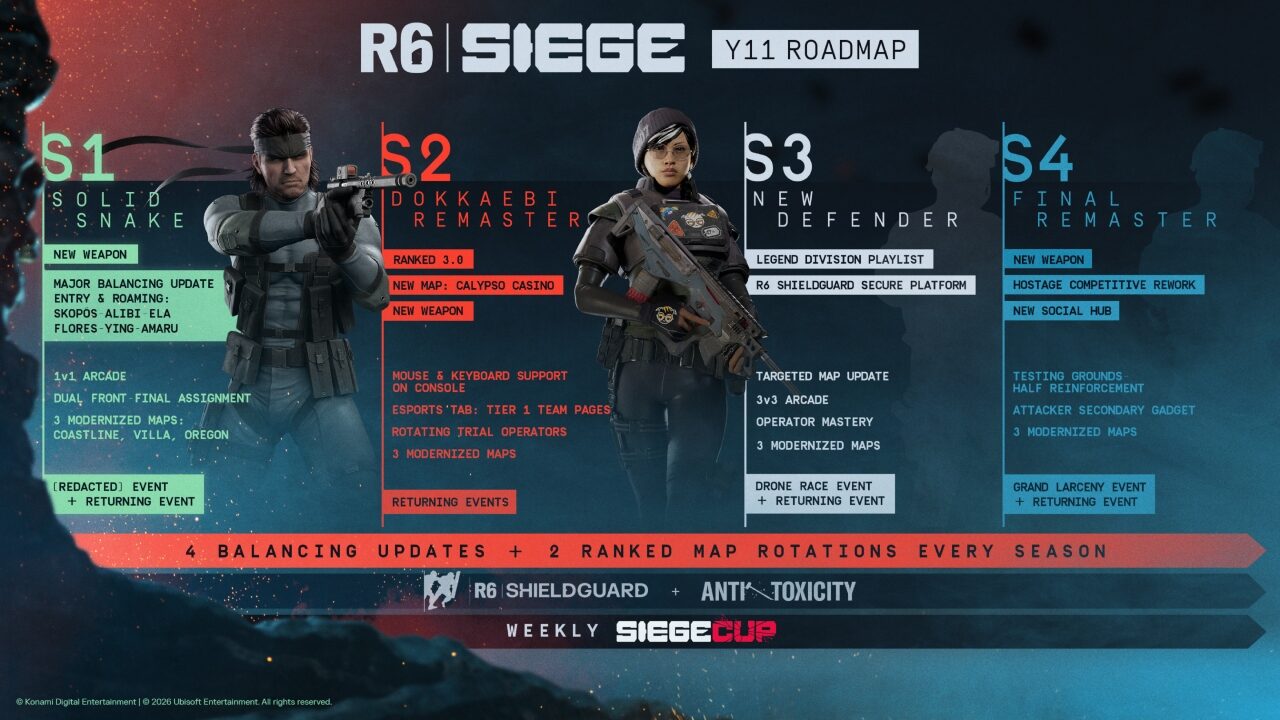
And the second part, oh, man. So Year 11 is a really special year for us because we’re building a new cadence of content. Now, I’m being a developer nerd about this, but what that means is by Year 11 Season 3, our full cadence structure will be in place. This is like Legend of Vision will be activating targeted map updates, all the different features that we’re bringing online.
But this is like the new bedrock of how we do seasons going forward. So that sets a really good foundation for everything to come. We’ll have key features that drop on top of that. But the point being, every season we’ll have plenty of stuff going on every three weeks. It’s going to be fantastic.

Rainbow Six Siege Year 11 will be here soon, so you won’t have to wait long to get your hands on Metal Gear Solid’s Solid Snake, or any of the other updates coming to the game.