
When Project Songbird was offered to us for review, naturally, I had to take a look at it. For what am I if not the Penitent One, travelling along my pilgrimage of indie horror games? It is a difficult journey, but one that brings both sorrow and joy—and every step, an opportunity to learn and grow.
Project Songbird feels to me like the good version of Layers of Fear—insofar as its central premise is the existential horror of artistic expression and fear that comes from creating something niche that reflects your vision vs. creating soulless slop for the masses. Its puzzles aren’t obnoxiously obtuse, its tension-building is subtle, and while it’s not the most scary, it certainly didn’t annoy me as other “horror” games have.

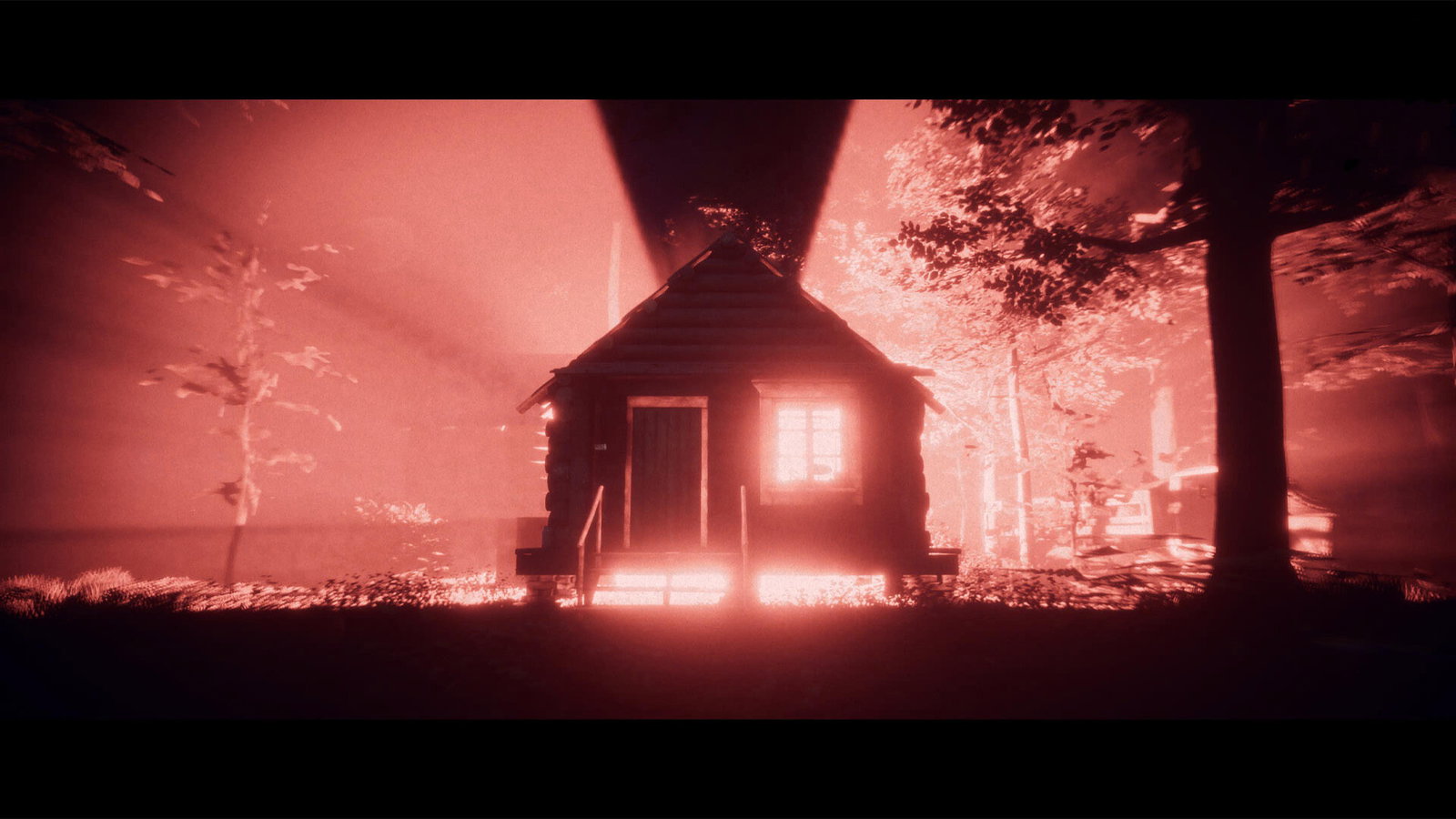
The game centers around Dakota—a fairly well-known musician who is struggling not only with writer’s block, but they’re at an emotional crossroads where the music they want to make isn’t exactly the stuff that sells. Their producer offers them a month-long stay at an isolated cabin where they can be among nature and maybe get out a few hits. However, strange things begin to occur, and Dakota very quickly needs to start facing the literal and figurative demons of her past so that she can finally move forward.
I honestly didn’t think I was going to like Dakota as a character since, at the start of the game, there’s a bunch of interactable objects within their apartment, and one of them is a computer screen highlighting a negative review of one of their songs—whereupon Dakota essentially gets mad at the critic for being pretentious. Afterwards, I found a record player where the player can choose to listen to some music, and after putting on a record, Dakota almost immediately gets really critical of the band.
Maybe I read into it a little more than I should have, but it just seemed incredibly hypocritical of a character whose defining feature is: artist being driven mad by their art. Not only that, but the game starts with an earnest imploring from the developer about the hard work that went into development, how much they hope you enjoy it, which always comes off a bit desperate to me. Maybe I took it a little personally since it always bugs me when artist-types slag off critics like we don’t know anything about art, or contribute nothing to the creative process.

However, as time went on and I spent more time with them, despite a somewhat predictable story, they started to become a much more relatable person. Project Songbird does do an admirable job in the quieter moments of trying to get the player behind the mindset of creating art and the frustrations or tragedies that can come with it when it just isn’t working.
Gameplay in Project Songbird is a bit mundane, but serviceable. It bears all the hallmarks of a narratively driven horror game—quiet reflection, puzzle solving, sneaking past monsters, finding keys to open locked doors—but none of it ever came across as amateurish or obnoxious, except for one moment, but I’ll get to that.
“Visually, Project Songbird is kind of like early Phasmaphobia insofar as it’s not really anything to write home about, but it still manages a solid sense of atmosphere.”
I genuinely let out a sigh of relief when I was confronted with my first puzzle that seemed like it was withholding information as a way of contriving difficulty, but wouldn’t you know it, Project Songbird actually followed the tenets of good puzzle design, and my actual ability to solve it was what was initially in the way. And as I progressed, every puzzle gave me all the necessary information and relied on me to solve it.
However, where Project Songbird does falter a bit is in the horror department. While it does have a few decent moments, the overall horror experience is pretty lacking due in large part to Dakota being given weapons right from the beginning—or at all—and the monster designs being a bit goofy. At no point was I ever scared around them simply because their presence doesn’t evoke terror, and if you’re good at timing blocks, you can dispatch them pretty easily.

Where it gets a bit worse is when Project Songbird introduces its “Weeping Angel” enemy, specifically in an area where you need to not only run through a maze, but also press specific keys on assorted pianos for the sake of puzzle solving. I’ve never thought needing to solve puzzles while running through mazes was all that tense or scary, and what’s especially annoying is that there’s no way to juke these monsters so you can use the piano uninhibited.
The moment you turn your back to them, even if you’re not in their eyeline, they charge towards you like an angry cheetah. The second act of the game really came close to pushing my annoyance button with this SCP nonsense, so Connor, if you’re reading this, don’t do this; it’s no fun.
Visually, Project Songbird is kind of like early Phasmaphobia insofar as it’s not really anything to write home about, but it still manages a solid sense of atmosphere. While its moment-to-moment environments aren’t particularly outstanding, they work well for presenting a somewhat warped version of Dakota’s past. And in certain scripted moments, it utilizes genuinely striking and strange visuals to give the game an ephemeral atmosphere that blurs the lines between perception and reality.

In the audio department, Project Songbird is a little hit and miss. The game uses an understated soundtrack in its quieter moments that adds a sense of unnerving calm to the game. Valerie Rose Lohman does an excellent job voicing Dakota and giving them a sense of relatability. However, some of the monster sounds are on fairly noticeable loops, taking away from their presence and showing their strings a bit.
While Project Songbird isn’t an amazing horror experience, it does feel like a labour of love, and one with a fairly competent understanding of the genre. Even during moments that I would scoff at, I found myself quickly thinking, “honestly though…this isn’t annoying me as much as other games.” It’s certainly an admirable attempt from a solo developer, and I hope it acts as a learning opportunity for bigger and better things!