
Videogame characters are always put into tough places.
From battlefields and covert operations behind enemy lines to jungles teeming with murderous beasts and haunted houses, players are used to guiding their digital personas through rough territory. As effective as these locales can be in inspiring a sense of danger, though, I’d venture that there’s one environment that is capable of providing more interesting — and more perilous — terrain for videogames: the human mind.
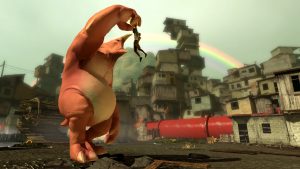
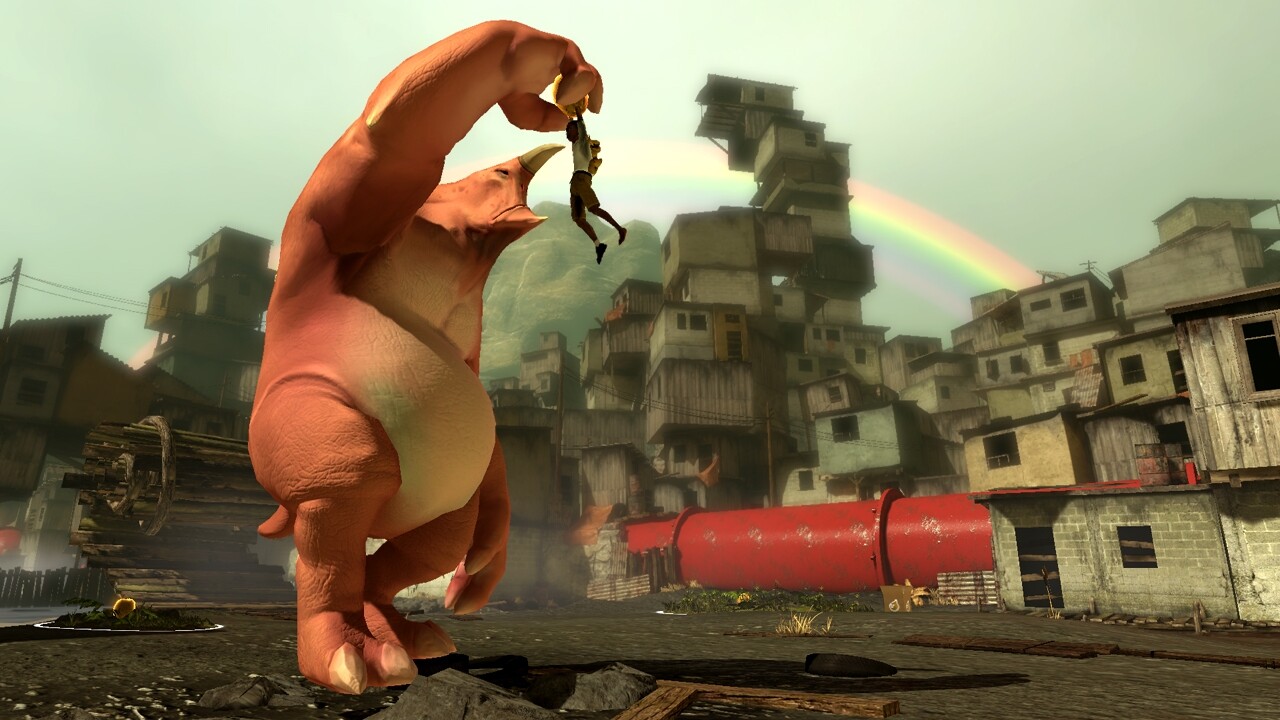
I’ve just finished reviewing Minority Media’s Papo & Yo and it left me with a number of lingering thoughts, including just how impressive the game’s metaphorical structure really was. Papo & Yo focuses on a boy who, attempting to escape from the reality of an abusive, drug and alcohol addicted father, flees to a world of imagination. In it, his favourite toy robot, Lula, becomes a superpowered companion, his father becomes a giant pink beast called Monster and the city streets of his home are capable of magically altering themselves through the manipulation of chalk drawings. All of it, aside from a few significant technical problems, works extremely well, providing a thorough exploration of the complex psychology of a child being abused by his/her father.
It all, of course, takes place inside its main character’s head. If Papo & Yo was presented differently — if it was, say, a game about hiding from a violent parent in a real-world house — it may still have been a powerful statement, but would likely have lost much of the nuance that its imaginary tact enables. Instead of fleeing a father who is portrayed as a one-dimensional villain, Papo & Yo’s fantasy version of abuse shows the different sides of that same antagonist by translating him into a creature that is (almost inexplicably) capable of showing love, indifference and irrational hate to his “child.”

American McGee’s Alice games take a similar, if less involved, approach by filtering the characters and plot points of Lewis Carroll’s classic Alice’s Adventures in Wonderland/Through the Looking-Glass and What Alice Found There through the lens of a disturbed young woman. Players set out across a dark version of Wonderland that reiterates on stories and characters familiar to the bulk of the game’s audience, providing a fresh take on Carroll’s work while simultaneously telling a new story regarding the real-world Alice. McGee’s use of psychological exploration may not possess the rich emotional landscape of Papo & Yo or the large, dynamic cast of characters as Psychonauts, but it does use its premise to effectively riff on post-traumatic stress disorder, 19
century British society’s attempts at coping with the immense changes inherent to the Industrial Revolution and one girl’s struggle to regain control over her mind.
Each of these titles demonstrates just how effectively a team of smart writers and designers can use the setting of the human mind to make truly compelling experiences. Of course, not every videogame would benefit from letting its players into the heads of its characters, but taking that approach when appropriate can only lead to great things. I’m tired of jungles, bombed out cities, industrial facilities and spaceships: let me play around inside the infinite possibilities of the mind.
***
Reid McCarter is a writer, editor and musician living and working in Toronto. He has written for sites and magazines including Kill Screen, The Escapist and C&G Magazine. He founded, writes and edits the videogame blog digitallovechild.com and is Twitter-ready @reidmccarter.