To say I have been excited for SAROS would be an understatement. I have been craving some chaotic action, and the second I saw Rahul Kohli tied to the title, I knew I couldn’t resist. Normally, you won’t see my name on CGM content surrounding PlayStation exclusives, as my partner and I don’t share well, but SAROS might be a title I will have to kick him off his console for.
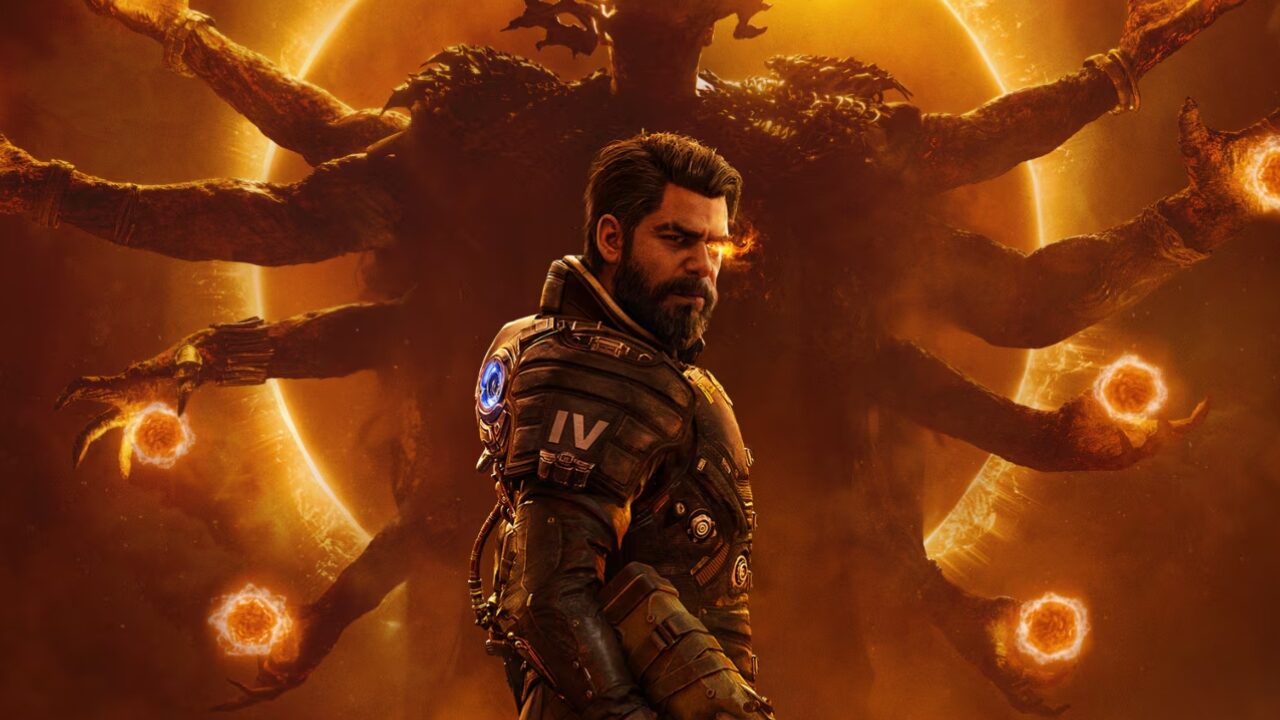
Rahul Kohli is often tied to voice acting, some great Mike Flanagan content, and, most recently, very exciting Diablo content. I have been a fan of his for a long time, not just because of his acting, but also his overall personality and social media presence. When I saw he would not only voice SAROS’s leading man, Arjun Devraj, but also serve as the face and voice capture, I was thrilled. Now after spending around three hours getting him killed over, and over, and over and over, I can confidently say I am blown away by SAROS and Kohli’s performance.

Everyone online says that SAROS is the “spiritual successor” to Housemarque’s last game, Returnal, which released in 2021, and then again on PC in 2023. After a short presentation from Housemarque and PR, we learned a little about what that means. They divided SAROS into three sections regarding how it compares to Returnal: preserving, improving and new. Their goal is to maintain striking audio and visuals, keep with the outstanding action and haunting stories Housemarque is known for, and continue to showcase what the PS5 can do.
“With SAROS, they intended to evolve combat and controls, implement deeper world-building, and include an autosave system at launch.”
With SAROS, they intended to evolve combat and controls, implement deeper world-building, and include an autosave system at launch (they mentioned this with a “You’re welcome,” and a snicker). As for what’s new, SAROS features a permanent progression system, a complete ensemble cast and a new mechanic called The Eclipse.
For this preview, I am not going to talk much about the story of SAROS. I think Housemarque titles really value their stories and the world around them, and sharing that prematurely could do players a disservice. In my notes, I wrote down several story-related moments, but the further I got, the more I wanted people to experience them the same way I did.

I played the very first three hours of SAROS, tutorial and all, including an introduction to many key characters. You play Arj, as I mentioned, but after your first death, you awake, finding out you’ve been gone for days, though it only felt like hours for you. As you travel through the world of Carcosa, between your deaths and rebirths, and many logs you find on your runs, you will see the story unfold in front of you, and slowly uncover what has happened, and everything you’ve missed.
Even three hours into the game, I can tell there are several gameplay mechanics that haven’t been uncovered yet. At this point, I had access to weapons, which were made up of a gun (rifles, pistols, etc.) and something called Prominence, which is a power weapon. You use your shield to absorb enemy bullets to charge your power weapon for bursts of damage or to counteract corruption, which I will touch on later. Moving through Carcosa, there were clearly areas I could access yet, and what looked like a grappling hook spot that would get me there later on.
SAROS is a roguelike that rewards you for each run with its permanent progression system. Every time you die, you are able to spend resources like Lucenite you collected at something called the Primary to gain bonuses to various skills, the amount of resources you collect and how fast, and even unlock the ability for stronger weapons. There is also a skill check, essentially called an Overlord Node, which stops you from progressing through the skill tree until you find and defeat certain powerful Overlords on the map.

While exploring Carcosa, after every death, you will find that the world is completely different. This plays into the dialogue, with Arj and the other characters discussing how it is never the same. Arj also comments on why he keeps coming back, which, at this point, we still don’t know. Arj is looking for something, though, and won’t give up until he finds it.
In each run, you will collect Artefacts, much like Returnal, which aid you during that specific run. Many are bonuses for things like Command, Integrity and Resiliance, but when I started lasting longer in runs, I noticed many come with negative side effects too, like stalling your weapon or less dashes available. I also learned the hard way that you have a limited number of Artefact spaces available, and you can’t swap them out when you’re full. I started stressing about what to choose and leave behind.

The final gameplay mechanic I want to mention is The Eclipse—and yes, it is just as ominous as it sounds. When you reach The Eclipse, enemies become stronger, and they begin using corrupted projectiles. These can’t be absorbed and used as power by Arj, and instead truly kick your ass. I wasn’t able to learn more about this mechanic as the play session was coming to an end by the time I reached The Eclipse, so I was just focused on survival. However, I did get to speak to the Creative Director on SAROS, Gregory Louden, and he shared a bit more insight into how the mechanic works, and even how you can use it to your advantage:
“…we always give you the ability to choose when to call The Eclipse. So in some biomes later in the game, it’s going to be a choice right from the get-go. Do you just escalate the world? Do you change Carcosa to be burning red from The Eclipse, to change the musical score when The Eclipse washes over and also have the kind of Eclipse escalation gameplay?”
He went on to explain how the gameplay changes with The Eclipse in more detail, “So that gameplay, even though it does add additional challenge, it also provides additional opportunity. The resources you collect to come back stronger, the way that you can overcome challenge. I don’t know if you noticed, but when you’re in The Eclipse you actually get more of that resource. So it’s almost in your interest to get to the device, call The Eclipse, collect all the resources you can, and then when you do succumb to the elements, you can essentially go back, upgrade yourself and then hit back hard and beat that boss.”

At this point, I was also facing some of the tougher enemies in the game, like bosses and minibosses. During the briefing, Louden said, “Easy to pick up, but hard to master.” Boooooy was he right. I had so much false confidence running through the first sections of the game, but my first miniboss destroyed me. Each run, I got a bit better and began to see patterns and mechanics, but it was a whirlwind. It doesn’t help that the character models are something from nightmares. Creatures twisted with features between nature and wings and tentacles, and eyeballs—I could go on.
“With only three hours of hands-on time with SAROS, I can confidently say that Housemarque has another hit on its hands.”
I mentioned being blown away by Kohli’s performance. Of course, in cutscenes and even small dialogue sections, he has depth and is believable, but one of my favourite things about it might be thanks to Housemarque. The music, voice, and sound effects combinded makes SAROS truly outstanding. The grunts, panting and heavy breathing after a battle make you feel like something of significance happened. The soundtrack paired with the vibrations of the DualSense controller makes it feel almost like a rhythm game at times. Housemarque has dubbed this a bullet ballet, and after playing SAROS, I completely understand what they meant now.
When asked about tips for players jumping into SAROS, he described more about the bullet ballet, “We’ve developed this game to always be basically it’s all about bullet interaction. Returnal is about avoidance. This game is about running into the bullets and actually using them. So the biggest tip I have is do not be afraid of projectiles. They’re not danger. They’re actually opportunity….Go into SAROS ready for the bullet ballet and be ready to dance with the bullets. Don’t run away, run towards them.”

Of course, we will have to see what the full SAROS experience brings, but with outstanding visuals, otherworldly audio, an intriguing story and satisfying combat, I think players are safe to get their hopes up for this one. With only three hours of hands-on time with SAROS, I can confidently say that Housemarque has another hit on its hands. Even this early in the year, I will call, at minimum, Best Audio & Sound Design, Best Action Game, and I wouldn’t be surprised to see it on the list for the 2026 Game of the Year.