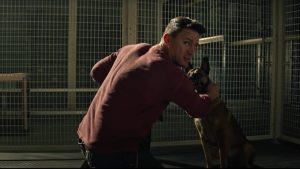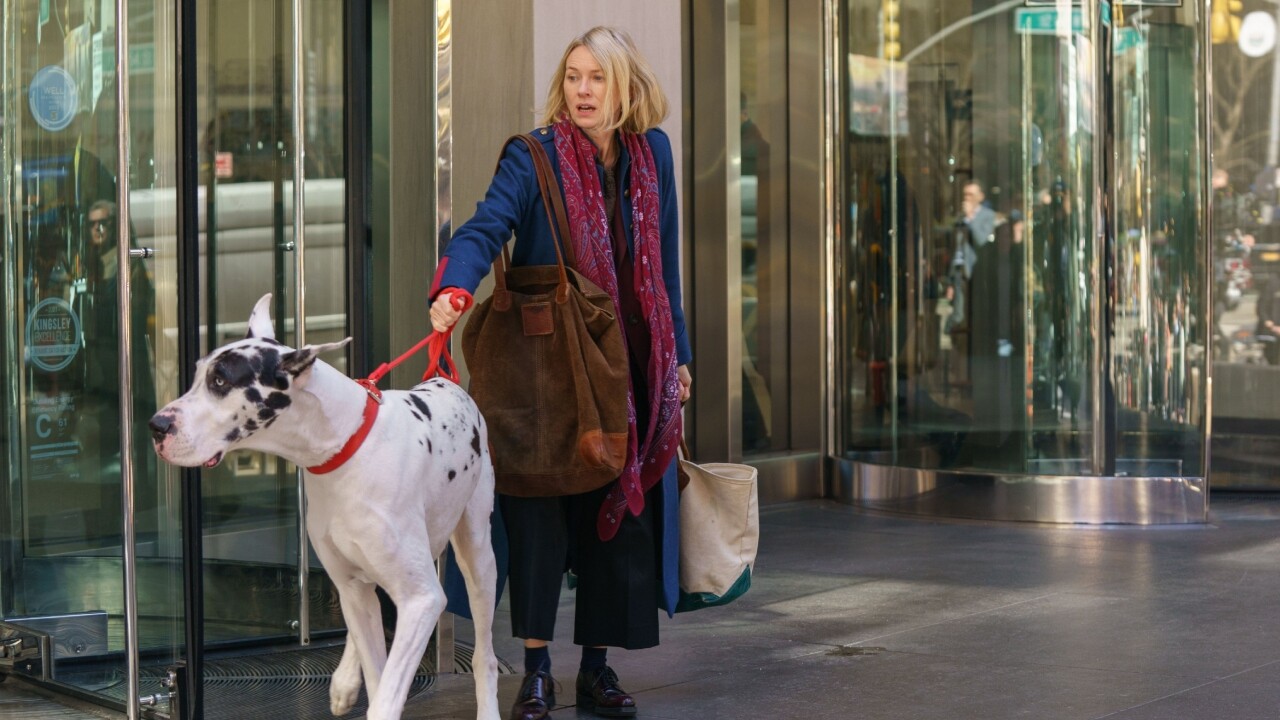


Murray, Naomi Watts and a giant dog. Though I’m not usually a fan of “animal films,” (I’m looking at you, Air Bud) Murray and Watts were enough to pique my interest. What I thought would be a silly dog movie turned out to be a film about closure, loss and grief, with some hard hitting emotional moments I just wasn’t expecting.
Trigger warning: Suicide.
The Friend follows Iris (Naomi Watts) after the death of Walter (Bill Murray) her former teacher, confidant and mentor. The two were close, and in his death he leaves his absolutely massive great dane to her and her tiny apartment. Iris spends the film searching for a place that will take Apollo (Bing), as her building won’t allow animals, and as the plot progresses she bonds with the sad pup that is missing its owner.
I firmly believe that we need our animals more than they need us. They can sense when we are sad, excited, scared, or just in need of a pick-me-up. In The Friend, Iris believes that Apollo needs her. Apollo becomes a way for Iris to hold onto her dear friend and control what she can. Maybe by saving Apollo, she hopes to reconcile with her inability to save Walter.
First and foremost, Bing the dog looked like the saddest good boy I’ve ever seen. Having met him on the red carpet at TIFF, I can confirm he is a happy pup. Now that that is out of the way, The Friend was a bit of a slow ride filled with awkward “my dog is big” moments throughout. Watts was able to work with Bing admirably and even without a human on screen partner, she had some really tender moments. As Iris and Walter are both writers in The Friend, narration comes in the form of excerpts read from novels—Walter’s past books, or books Iris is working on—and the phrase “What about the dog?” repeatedly pops up.

We meet Walter’s three ex-wives and current wife, slowly building a background about the famed author. Walter has several misconduct complaints, cheated on his wives, fathered a child he is only recently getting to know in her adulthood, and eventually commits suicide. In doing so, he leaves no note or preparations, aside from telling his current wife, in passing, that he would want Iris to take the dog if anything happened to him.
Murray playing an elderly man who has blurred the lines of appropriateness and slept with his students feels a little too on the nose for me. While Murray was excellent in the role—bringing the dry, dark humour and sadness required—the casting could have been handled more tastefully. That said, listening to Murray read was moving. The calmness and melancholy in his voice were comforting.
Though Apollo is a metaphor for Walter, he’s also a metaphor for Iris. She tries to save him like she couldn’t with Walter, but there is also so much of her in Apollo, too. Clearly, the grief of losing someone dear is evident in The Friend, but Apollo doesn’t understand where his master has gone, much like Iris can’t make sense of why Walter committed suicide or, at minimum, didn’t leave a note behind. She’s just as lost as the dog.
“In The Friend, writers and directors Scott McGehee and David Siegel and writer Sigrid Nunez perfectly capture the emotional and raw feelings that are left with those who live on after someone takes their life.”
The Friend is perfectly serviceable throughout, but it wasn’t until one of the final scenes after Iris is instructed to write through her grief, that I was completely sold. She uses her writing to confront Walter, and we get to sit in like a fly on the wall. Iris is in Walter’s home with a different dog—since this is a story—and she finally gets to say everything she never got the chance to.
As someone who lost their father to suicide, there is so much anger, pain and confusion left behind. In The Friend, writers and directors Scott McGehee and David Siegel and writer Sigrid Nunez perfectly capture the emotional and raw feelings that are left with those who live on after someone takes their life. I felt seen on screen, and that isn’t something that happens often when it comes to suicide and mental health.
The Friend was an interesting movie to start, but that scene turned it into a deeper exploration of grief outside of sadness. Performances were believable across the board, but Watts and Murray had a rapport that was truly believable, making the film great instead of just entertaining.
Check out more of CGMagazine’s TIFF 2024 coverage here throughout the festival.