

AMD had a strong 2025, with several CPU launches that dominated PC building rankings. The company now looks to build on that momentum with its latest release, the AMD Ryzen 7 9850X3D CPU. Much like its earlier X3D sibling, the 9850X3D builds on the 3D V-Cache technology that helped make the 9800X3D and other offerings so appealing for gaming. It also increases clock speeds, giving the chip a modest boost across a range of tests, with noticeable results. While it is not a game-changer, the 9850X3D offers a more powerful option for users on the AM5 platform, delivering real-world performance and improving on an already strong formula.
What makes this release especially appealing for gamers is that it offers another option for those seeking a top-tier system. The 3D V-Cache technology provides a significant gaming advantage over non-X3D CPUs, delivering stronger performance in many titles. Priced at $499, the processor sits above the Ryzen 7 9800X3D, which is currently available for about $465. It delivers measurable real-world gains, although expectations should be managed. While it is an improvement, it does not dramatically outperform existing CPU options.
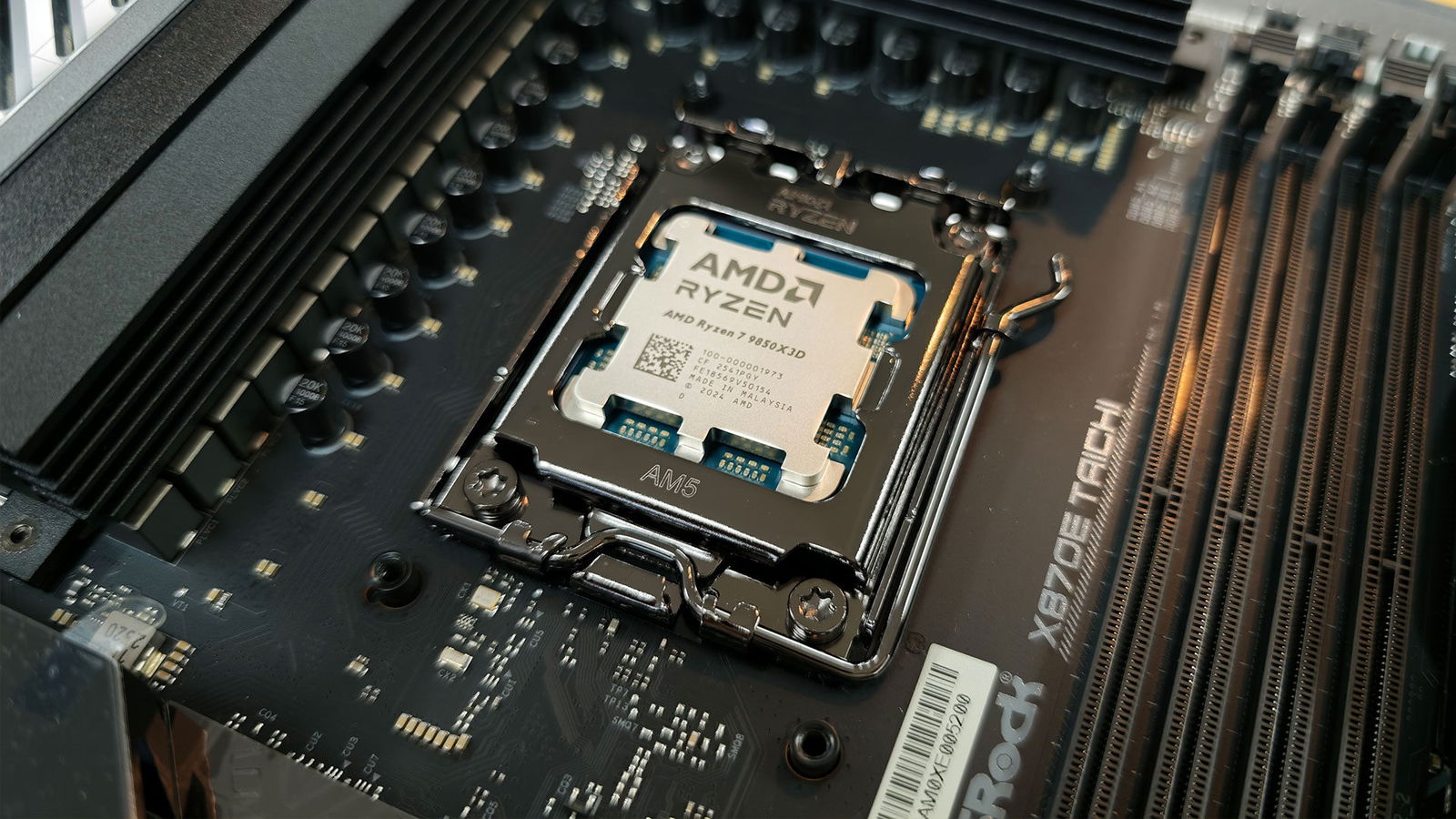
Notably, the Ryzen 7 9850X3D mirrors its sibling in nearly every meaningful way. It features eight Zen 5 cores with 96 MB of 3D V-Cache stacked beneath the compute die. This design allows more direct access to the integrated heat spreader, improving thermal performance and enabling full multiplier-based overclocking. Combined with 8 MB of L2 cache, the processor offers a total of 104 MB of cache.
What sets the new CPU apart comes down to its clock speed and how it performs under load. While the 9800X3D reaches a 5.2 GHz boost, the 9850X3D reaches 5.6 GHz, a 400 MHz increase that is the only hardware-level distinction between the two chips. Both share a 120-watt thermal design power, DDR5-5600 memory support and 16 threads. Those additional megahertz should translate into consistent performance gains, but real-world results are more subtle.
As noted in previous reviews of X3D chips, the benefits of 3D V-Cache are most apparent in gaming workloads, where these processors remain among the strongest options for gaming-focused builds. AMD says the 9800X3D delivers up to eight percent better gaming performance than its predecessor and up to 20 percent faster performance than competing processors. More importantly, the architecture excels at maintaining smooth gameplay, with notable improvements in minimum frame rates.

As with previous AMD Zen 5 reviews, including our review of the Ryzen 7 9800X3D, we configured our test bench to ensure no variables could skew the results. We used high-end components throughout the system, pairing the 9850X3D with an ASRock X870E Taichi motherboard, 32 GB of DDR5-6000 EXPO memory supplied by AMD, a Samsung 990 Pro Gen4 one-terabyte M.2 SSD and a 1,000-watt be quiet! power supply. The system was housed in a Cooler Master MF360 case and paired with an AMD Radeon RX 7900 XTX graphics card.


We began testing with synthetic benchmarks, where the Ryzen 7 9850X3D shows a measurable but modest performance improvement over the Ryzen 7 9800X3D. In many tests, the results are very close. This is expected, given how similar the two chips are, with the newer model offering only a slight increase in clock speeds. For users looking to extract the most performance from a gaming-focused CPU, it is still an improvement and allows systems to operate closer to their peak potential. In benchmarks such as 3DMark Time Spy, gains are minor, but the pattern of small improvements remains consistent across most of our tests.


Even in Blender rendering benchmarks, the Ryzen 7 9850X3D produced solid results compared with the 9800X3D. That said, while it is a strong gaming-focused CPU, it falls short in more demanding workflows such as rendering, which is reflected in these tests. Although performance remains respectable, higher-end Ryzen 9 and competing Intel processors delivered stronger results. This is an important consideration for users seeking a dual-purpose system for gaming and content creation.


Gaming is where the improvements are most apparent and where the Ryzen 7 9850X3D makes its strongest case for the higher upfront cost. In our Cyberpunk 2077 benchmark, the CPU delivered a clear improvement over the 9800X3D and outperformed every other processor we tested on a comparable system. Similar results were seen in Assassin’s Creed Mirage and Assassin’s Creed Valhalla, where it posted the strongest benchmark results in our recent charts.


In Watch Dogs: Legion, the 9800X3D and the 9850X3D tied for first, averaging 243 frames per second, consistent with broader performance trends across our benchmarks. The strongest showing for the 9850X3D came in Total War: Warhammer 3, where it delivered leading results in the ultra settings benchmark, topping the charts against every CPU we have tested. It trailed some flagship processors in certain scenarios, but it still posted a meaningful uplift over the 9800X3D, scoring 538 versus 518, a 3.8 percent difference.
“AMD says the 9800X3D delivers up to eight percent better gaming performance than its predecessor and up to 20 percent faster performance than competing processors.”
Sadly, this modest uptick in gaming performance comes with a higher power draw from the Ryzen 7 9850X3D, something that is expected but worth noting. During gaming workloads, the processor draws roughly 30 percent more power than the 9800X3D, a substantial increase that does not scale proportionally with the performance gains. While the chip runs relatively cool, overall power efficiency clearly favours the 9800X3D, which aligns with the differences in their specifications. The higher clock speeds require additional power, a trade-off reflected consistently across our benchmark results.

Content creation testing produced results very similar to those seen with the Ryzen 7 9800X3D, but performance remained solid, depending on your needs. In DaVinci Resolve, everything ran smoothly, with no stuttering or notable slowdowns.
In the Puget benchmarks, the 9850X3D scored slightly above the 9800X3D and below the 9950X3D, placing it solidly within the full X3D lineup. Results were stronger in the Photoshop benchmark, where it edged out both the 9950X3D and the 9800X3D, even if only by a small margin.

Adobe Premiere Pro performance was also consistent. The 9850X3D scored just below the Intel Core Ultra 9 285K but ahead of the 9950X3D. Overall, the 9850X3D is a solid performer. However, given the price increase over the 9800X3D, it is debatable whether most users would notice a meaningful difference, and it may not be worth the extra expense for those on tighter budgets.

After reviewing the numbers, the performance gap between the 9850X3D and its predecessor is less dramatic than expected. The AMD Ryzen 9850X3D is a solid processor, but it represents a modest improvement rather than a compelling upgrade for users who already own the 9800X3D. The 12-core Ryzen 9 9900X3D sells for about $599 and offers additional cores while maintaining strong gaming performance, while the 16-core Ryzen 9 9950X3D tops the lineup at roughly $699. Against that backdrop, the 9850X3D is difficult to position, as it offers fewer cores than the next tier up while costing more than the processor it only narrowly outperforms.
“AMD’s X3D processors continue to lead in gaming performance, often maintaining double-digit advantages over Intel’s offerings and AMD’s own non-X3D chips.”
It makes sense for buyers seeking strong gaming performance without stepping up to the 9900X3D, particularly since many games still favour the 9850X3D. While the 9850X3D can be seen as an option for those chasing peak gaming performance, most users are unlikely to notice a meaningful difference in real-world testing, with gains remaining minor outside of a small number of titles. Still, with only a marginal price difference, if you are buying a new system or upgrading from a slower CPU, the performance boost is worth the extra investment.
While reviewing the chip, it was hard not to think of Intel’s KS processors, which are binned parts with higher clock speeds aimed at enthusiasts willing to pay a premium for marginal gains. The key difference lies in positioning. Intel’s KS models sit at the very top of their respective lineups. The Ryzen 7 9850X3D does not occupy that role, as AMD already offers clear flagship products, even within the X3D range. Instead, this processor sits in an awkward middle ground, technically superior on paper but offering little that the average buyer is likely to notice once they start playing games.

That said, AMD’s X3D processors continue to lead in gaming performance, often maintaining double-digit advantages over Intel’s offerings and AMD’s own non-X3D chips. While this assessment may sound critical of the latest release, it reflects the strength of AMD’s existing lineup, which makes it difficult for this new processor to clearly stand out. Intel has yet to offer a meaningful response to 3D V-Cache technology, which makes the 9850X3D’s lack of a clear identity more notable, as its primary competition comes from within AMD’s own product stack.
That does not make it a weak processor, but it does make it harder to define who it is best suited for. If pricing remains stable, scenarios in which the 9850X3D is the best choice are relatively rare. Some gamers may appreciate occasional high single-digit gains in specific titles, but those improvements do not consistently justify the price premium or the increased power consumption. Time will ultimately tell, but with both the 9800X3D and the 9850X3D delivering solid results, buyers are likely to end up with a strong option regardless of which direction they choose.
I approached this review uncertain how the Ryzen 7 9850X3D would compare with processors already on the market, and that uncertainty remains. After testing, it feels less like a clear consumer recommendation and more like a strategic product for AMD. The processor achieves its primary goal of becoming the world’s fastest gaming CPU through higher clock speeds and proven X3D technology. For those building a high-end gaming PC in 2026 and seeking what is arguably the best gaming processor available, this is a logical choice.