

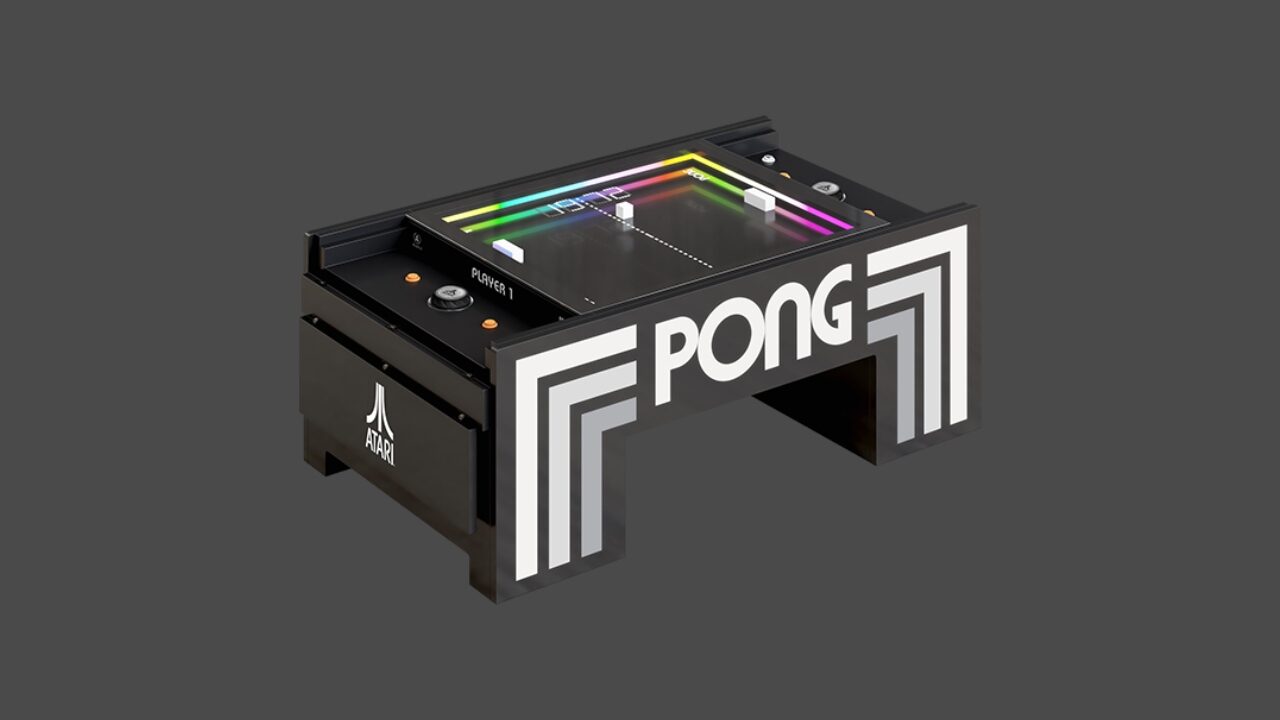
The Arcade Floor
In August 1972, Atari placed a Pong prototype in Andy Capp’s Tavern in Sunnyvale, California. Players queued to use it, and so many coins went in that the coin box overflowed and the machine stopped working. Pong was released in November 1972 and became the first commercially successful arcade video game. By 1974, Atari had sold more than 8,000 machines.
What matters for discovery is where that first cabinet stood. Pong sat alongside a jukebox and pinball machines, and nobody searched for it. Players found games by walking past them and playing. The machine had to make its own case from the corner of a bar.
Designers understood this early. Atari’s 1973 game Gotcha shows an early attract mode: when time runs out, the game resets and its shapes keep moving on screen to draw in the next player. The cabinet advertised itself to whoever happened to be passing. Discovery was physical, local, and limited by the size of the room.
Space Invaders, from Taito in 1978, and Namco’s Pac-Man in 1980 began a golden age of arcades that lasted until about 1983. Cabinets spread to pubs, chip shops, laundrettes and motorway services, anywhere with floor space and a plug. Space Invaders also added a high-score system and rising difficulty, which made the arcade a place of rivalry. A game could now be found through someone else’s initials at the top of the screen. The shelf was short, but everything on it was in plain sight.
The Storefront
Steam replaced the room with a catalogue, and the question of what appears in that catalogue has passed through three designs. Before August 2012, Valve decided by hand which games appeared on Steam. Steam Greenlight, which ran from August 2012 to June 2017, let users vote on which games would be listed. Steam Direct replaced it in June 2017.
Each change widened the door, and the numbers followed. SteamDB data shows 2,822 releases in 2015 and 4,648 in 2016. By 2024, the figure was about 18,500, and 2025 set a record with more than 19,000. As of 20 August 2026, SteamDB listed 16,115 releases for the year, almost 70 a day.
Abundance changes what failure looks like. Of the 2025 releases, 9,327 had fewer than 10 user reviews, again from SteamDB data. Close to half of that year’s games left almost no public trace. In the arcade, a weak cabinet was at least seen before it was ignored. On a storefront, a game can be released and never pass in front of anyone.
Valve’s response has been a stack of discovery tools: wishlists, the Discovery Queue, curators, user tags, personalized recommendations, New and Trending sections, and Top Sellers lists. Each is an attempt to rebuild the walk past the cabinet in software. Developers have learned to work these systems directly, organizing third-party sales to win a Steam genre tag so that players can find their games. In this model, a label is a location. Being filed under the right word is the digital version of standing near the door.

Endless Lobbies
The lobby is the same problem in another shape. Online game services present their libraries in a lobby, a screen of titles that players browse and search. It borrows from both earlier eras: the catalogue logic of the storefront, and something of the arcade floor’s single glance across a room of options. The page listing the games available at NetBet on its Irish site is one example of the format, a service listing the games it offers in one place.
What the lobby does not escape is the question of order. A lobby, like a storefront, depends on the service to decide what is shown first, and that first row matters because it is the one part of the library every visitor is certain to see. Everything below it has to be scrolled to, searched for, or already known. The attract mode of Gotcha has become a layout decision.
Who Chooses Now
Seen from here, the arcade and the lobby are less different than they look. In both, the scarce thing is not games but attention. Pong’s coin box overflowed because there was one machine and a queue. On Steam in 2025, the queue ran the other way: more than 19,000 games waiting, and 9,327 of them gathering fewer than 10 reviews.
That leaves two broad ways of deciding what a player sees. One is algorithmic: tags, queues, personalized recommendations and sales charts, systems that sort a catalogue by what players have already done. The other is editorial. Curators already sit inside Steam’s own toolset, and independent games publications apply their own editorial criteria to the same catalogue, offering a human route through it. The algorithm sees everything but judges by signals. The editor sees far less but can explain a choice, argue for an odd game, or point at something no tag would surface.
Neither route settles the problem, and the history suggests it may not be the kind of problem that gets settled. The arcade floor solved discovery by keeping the choice small. The storefront and the lobby made the choice enormous and then had to build ways of making it feel small again. Somewhere between the ranked row and the written recommendation, a player still has to decide what to try next. Human selection is one way through that decision, a route chosen by someone who looked first.