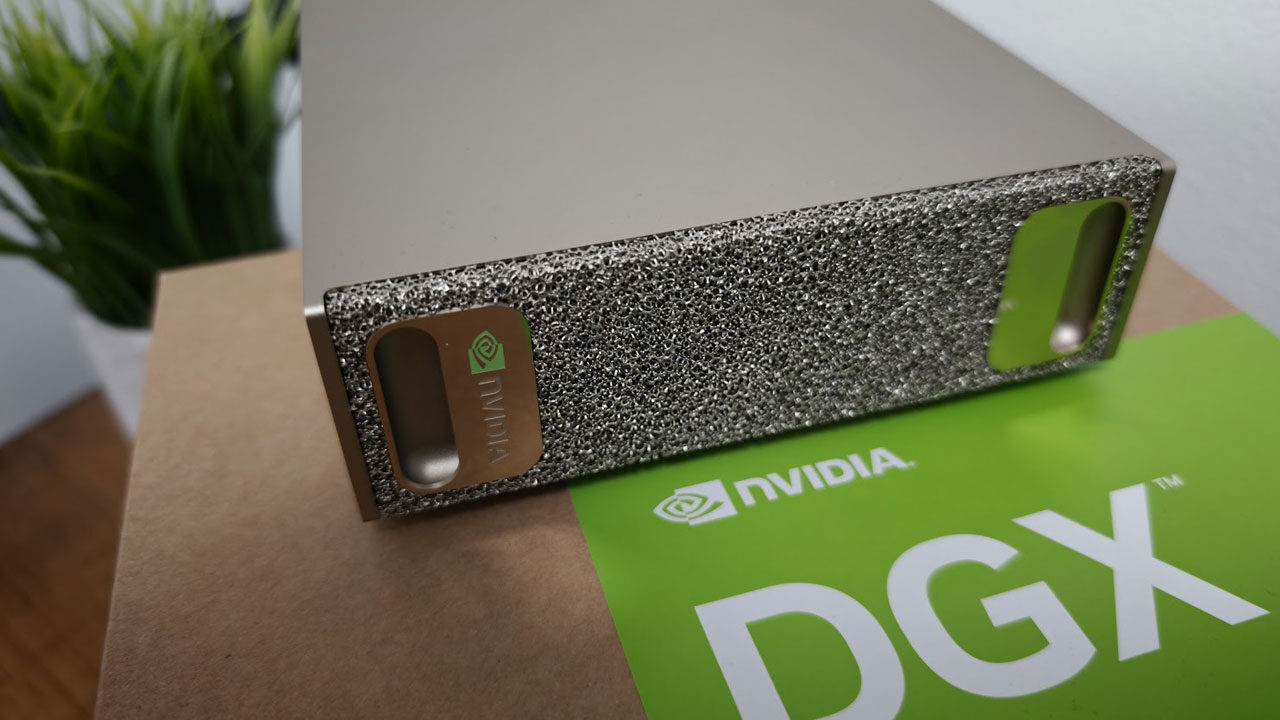
NVIDIA is expanding its DGX Spark personal AI supercomputer line with a new 64GB unified memory configuration, paired with software tools to make the process as painless as possible.
The NVIDIA DGX Spark has been a hit with AI enthusiasts and people who want a mini supercomputer in their home, and now NVIDIA is giving users a new option for diving into the world of DGX Spark. The new model launches Friday, Oct. 23, exclusively through OEM partners Acer, ASUS, Dell, GIGABYTE, HP and MSI, with pricing starting at $4,999 US.
The new 64 GB version retains the same GB10 Grace Blackwell Superchip, DGX OS and full NVIDIA AI software stack as the existing 128 GB model, allowing users to run models with up to 100 billion parameters entirely on-device with no cloud dependency. CUDA libraries, inference frameworks and developer tools come preconfigured, so users can run agents from day one through frameworks such as llama.cpp, Ollama, vLLM and LM Studio.
The clustering is handled by NVIDIA Sync’s Cluster Assistant, though the tool itself is not new. NVIDIA first rolled it out in a June software update, where it supports linking as many as four Spark systems when using a network switch. The assistant automatically detects connected units, validates each device’s configuration and sets up the ConnectX-7 network, so scaling from one unit to two requires no reconfiguration of the software environment.
For people who want to get the most out of their clusters, NVIDIA also announced that at the end of the month, NVIDIA Sync Model Launcher is coming and is designed to simplify deployment further, letting developers download and launch models such as Qwen3.8-27B across a single Spark or a cluster with a few clicks.
Sync configures the model to run across connected devices, makes it accessible from the user’s laptop, and sets up OpenCode so developers can start coding directly in a browser. For people who already have one or more DGX Sparks, this is a great thing to see, and a good way for people new to Linux and home development to utalize the full power of a DGX Spark.
Every DGX Spark ships with a built-in ConnectX-7 network interface out of the box. Two units connect directly with a QSFP cable over a 200 GbE fabric, pooling their unified memory to 128GB, doubling memory bandwidth and expanding model support to as many as 200 billion parameters. That clustered setup delivers up to 1.7 times the performance of a single unit, and in NVIDIA’s own Qwen 3.8 27B testing, two clustered 64GB systems delivered up to 70 per cent higher performance than a single 128GB system.
For anyone who has been on the fence about building a home lab with the NVIDIA DGX Spark, this new offering makes the idea a bit less prohibitive. The new 64 GB model can do almost everything the current 128 GB model can, aside from the obvious memory limitation, and it still supports clustering so you can build out your setup as needed.
It should be noted that while you can link a 128 GB DGX Spark with a 64 GB model, the cluster will be limited to 64 GB of RAM because of how the machines are designed, so this may not be the best option for people looking to expand an existing 128 GB setup. Still, for anyone looking to dip their toes into home development for a range of workloads, the new model offers a more accessible entry point, and that is never a bad thing.