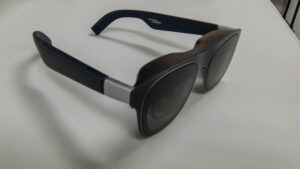
The XREAL AURA has just opened up pre-orders for customers who reserved, with pricing for the 256GB and 512GB models now available.
XREAL is finally ready to launch their new AURA glasses, and the company has shared pricing and pre-order info today. The XREAL AURA will start at $1,279 for the 256GB model with 12GB of RAM, and $1,499 for the 512GB version with 16GB of RAM. Those who previously made a reservation deposit can now pre-order at XREAL.com/aura, choosing the glasses in M (60-66mm) or L (66-72mm). The first wave of availability covers the United States, Canada, Japan, and Korea. Customers in those regions should be able to go hands-on with their XREAL AURA units in mid‑November. Everyone else will have to wait a bit longer, as additional markets are scheduled to roll out in 2027.
In a release, XREAL explained the pre-order process: “Customers who already reserved AURA with an initial deposit will receive an email today with details on completing their purchase, selecting their configuration and next steps. Due to high demand and high reservations for AURA, only those who already reserved AURA prior to October 7 will be eligible to pre-order AURA and complete their purchases starting today. General availability orders for AURA will be available at launch.”
*XREAL AURA Regional pricing for 12GB RAM + 256GB/16GB RAM + 512GB storage:
- United States: $1,279 / $1,499
- Canada: $1,829 / $2,149
- Japan: ¥229,800 / ¥269,800
- South Korea: ₩1,990,000 / ₩2,290,000
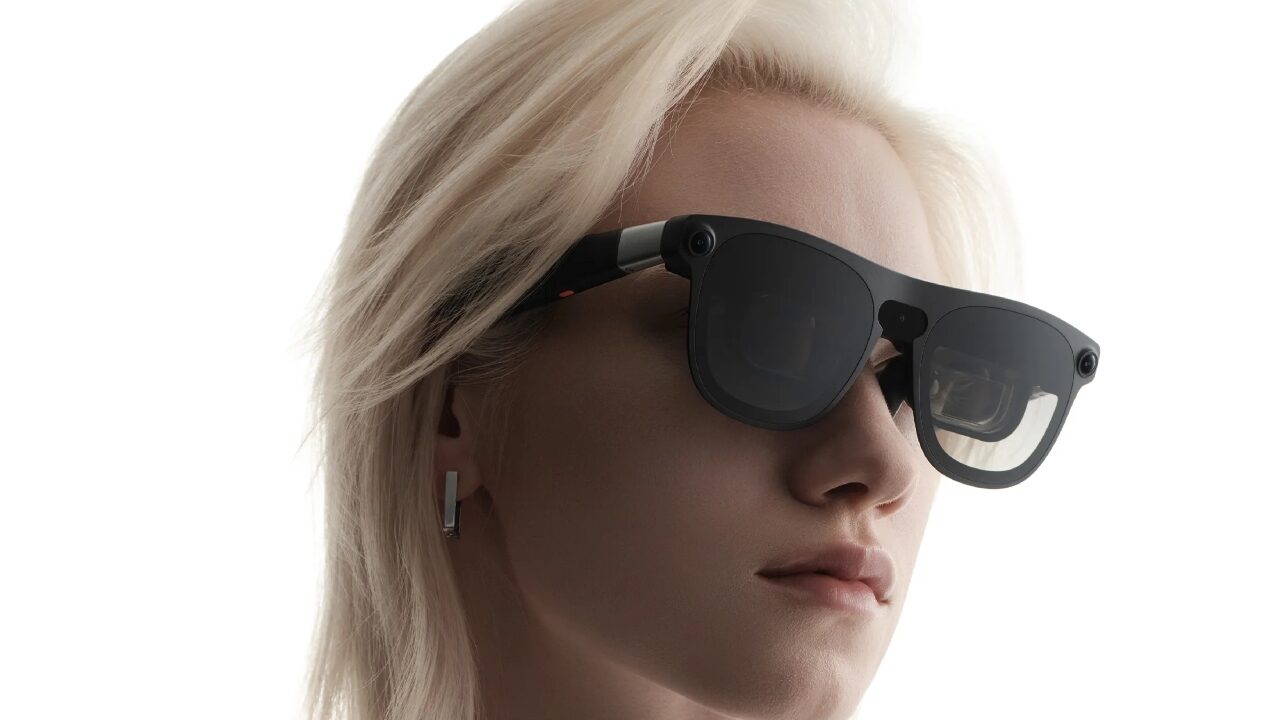
XREAL AURA is their answer to making spatial computing feel more like everyday eyewear rather than a bulky headset. The glasses use the company’s X Prism optics to deliver a 70‑degree field of view, paired with Sony micro‑OLED displays that run at 1920 × 1200 per eye and can refresh up to 120Hz. The lenses can shift between different transparency levels thanks to electrochromic dimming, which lets you decide how much of the real world you want visible while using apps or watching content.
To support spatial interaction, the XREAL AURA includes dual world‑facing cameras, full six‑degree‑of‑freedom tracking, hand tracking, and a front camera with a privacy indicator. Audio comes from a Bose‑tuned setup with spatial audio support, and a four‑microphone array handles voice input.
“With a premium price and a phased rollout, AURA is shaping up to be one of XREAL’s biggest pushes yet into mainstream spatial computing.”
The XREAL AURA still requires a separate puck running Android XR on the Snapdragon Reality Elite platform. Depending on the model, the puck offers either 12GB RAM with 256GB of storage or 16GB RAM with 512GB. It also includes a 4,455 mAh battery, multiple USB‑C ports, Wi‑Fi 6/6E, and Bluetooth 5.3. Luckily, the glasses, puck, charging cable and connecting cable all come together with a cleaning cloth in a neat little case.
When I was invited to Snapdragon Summit by Qualcomm last month, I was able to sit down and put the XREAL AURA to the test. Something that was completely not relevant to me, but still incredibly impressive, was its use in the medical field. We were able to move through MRIs and brain scans in 3D, and it was so cool! I was also able to test it a bit for gamers and for standard users, too.
In gaming, I played a point-and-shoot VR-like game and though the depth perception took some getting used to, it was cool to be able to play games like this without an entire VR setup. Likewise, we played a tabletop game that saw us physically looking down on a castle, able to pick up and move pieces, choose cards and battle. I was able to pull the board closer to me and rotate it—it certainly beats the family dining room table.
For workloads, though this still involved going hands-on with a laptop, I was able to view the monitor in the glasses and navigate on the device. I could spread the windows out across the room. I could use the glasses to speak to Gemini about what I was seeing, and in one instance it was able to bring up other articles supporting what I was looking for. Of course, I will need more time to see all the XREAL AURA can really do and how it works in real-world testing. As someone who usually gets sick with VR headsets, I didn’t with the XREAL AURA, and I am eager to see more.
XREAL says the AURA will support the full Android XR ecosystem, including Google Play access and more than 100 XR‑specific apps at launch. Gemini AI is built into the system for spatial and contextual assistance. With a premium price and a phased rollout, AURA is shaping up to be one of XREAL’s biggest pushes yet into mainstream spatial computing.